Within any language or language group there may be significant changes in speech, vocabulary, and pronunciation. The term used to describe these changes is called a dialect. Some words or phrases that exist in one dialect may exist or be absent from different dialect. The common dialect in Arabic language is called Modern Standard Arabic (MSA). This dialect is understood or spoken as a second dialect by more than 206 million Arabic-speaking people. MSA is spoken in most formal situations, such as radio broadcasts, lectures and sermons, since it’s one of the most commonly understood Arabic dialects.
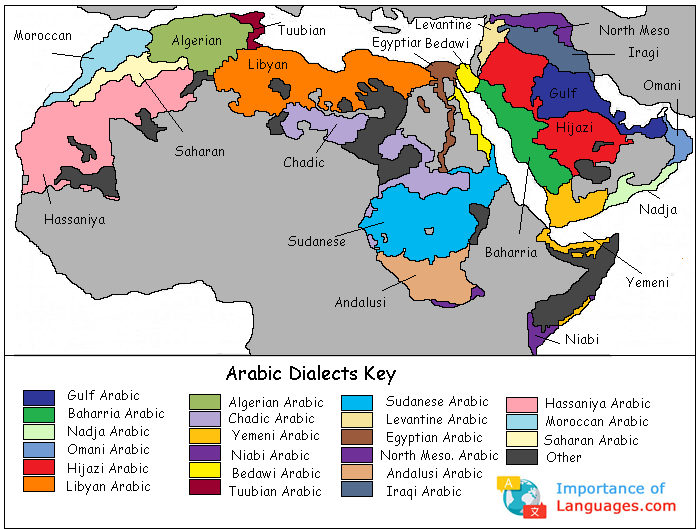
Arabic Dialects Map
Map of the different Arabic Language Dialects
Arabic Dialects List
Sudanese Arabic – Mostly spoken in the Sudan
Levantine Arabic – This dialect is often heard in Syria, Lebanon, Palestine, and western Jordan
Gulf Arabic – Mostly heard throughout the Gulf Coast from Kuwait to Oman
Najdi Arabic – This dialect is most often heard in the desert and oasis areas of central Saudi Arabia
Yemeni Arabic – This dialect is most common to Yemen
Iraqi Arabic – The dialect most commonly spoken in Iraq
Hijazi Arabic – This dialect is spoken in the area west of present-day Saudi Arabia, which is referred to as the Hejaz region.
Egyptian Arabic – This is considered the most widely spoken and understood “second dialect.” It’s mostly heard in Egypt
Maghreb Arabic – Spoken mostly in Algeria, Tunis, Morocco, and western Libya
Hassaniiya Arabic – Most often spoken in Mauritania
Andalusi Arabic – This dialect of the Arabic language is now extinct, but it still holds an important place in literary history.
Maltese Arabic – This form of Arabic dialect is most often found in Malta.
Different Arabic dialects of the Arabic language are spoken in many different nations and regions around northern Africa and the Middle Eastern nations. However, in many areas, the differences in regional dialects may make one Arabic speaker nearly incomprehensible to another. In most cases, the different dialects don’t have a specific written form of the language, but there’s usually a certain amount of literature that accompanies each dialect, including poetry and plays. This is especially true for the dialects spoken in Egypt and Lebanon.
Interested in further study into Arabic or confused on where to start? I recommend reading our Arabic Beginners Guide
Learn Arabic Alphabet is very important when it comes to learning to write and read the Arabic Language. So make sure to practice pronouncing and writing the Arabic Alphabet whenever you can. As many times as you can.
Arabic Alphabet Table
Arabic alphabet letters are written horizontally from right to left.
Arabic numbers are written the opposite way, left to right. The Arabic alphabet contains Arabic letters in which most of them are constants. Learn Arabic Alphabet has no capital or lower case letters but does changes slightly depending on the position of the letter in the word. Vowel diacritics and other symbols mark if Arabic vowels are either long or short or pronounced differently.
Arabic vowel diacritics
Learn Arabic Alphabet is written like cursive writing where the Arabic letters are linked together. As mentioned above each Arabic Alphabet letter has four forms depending on where it is located within the word. Theses four forms are called: Isolated, Initial, Medial, and Final. Refer to the chart below for further explanation of what each one means and what each letter looks like when in that form.
Six Arabic alphabet letters (a(??)? d(??) d(??) z(??) r(?) w(??)) only have two forms.(Isolated and Final). Example Arabic word below to demonstrate this.
Arabic Alphabet Written Table
In the example “Marhaba” or Hello in Arabic. Since the Arabic letters for “a” and “r” have no medial forms causes the “r” to be in it’s final form causing the break in the word. So don’t stress out if there is a break within the word your trying to pronounce. Complete chart to Learn Arabic Alphabet letter when written in each of the four forms.
The first Question you might have is, what exactly is Calligraphy?
A Calligraphy is a stylized form of writing of many of the world’s languages. The origin of calligraphy finds its roots over a thousand years ago way back to the 600 B.C. period. These old calligraphy styles were practised in Italy, Rome and East Asian areas.
The famous Western calligraphy uses the Roman alphabet in its style by employing Etruscan, Greek and Phoenician alphabets. Though this is an old calligraphy style it is used even to this day as in the past, in the writing of holy books, especially in monasteries. The many wars and the rise and fall of empires made the art of calligraphy flourish and the various styles revolve around their local regions such as French, Anglo-Saxon and Celtic.
The old calligraphy style of Gothic calligraphy, originating from the 8th century, is easy to read and hence it is used even today in calligraphy writing. The other versions are more elaborate in appearance but not readable by all people, except those who are familiar with the lettering.
The Cyrillic alphabet was developed from Slavonic lettering from countries like Croatia and Bulgaria and is very widely used even today. The old calligraphy of these countries originally had 43 letters but today the Serbian language has been introduced that is similar to the older versions of Russian letters. The script is Unicial and makes use of straight lines that make it easily readable.
Dating back to the 200 B.C. period, the East Asian old calligraphy used pieces of parchment that cannot be found today. However, a few tablets with dried ink prove that old calligraphy existed amongst the Chinese and Japanese writers who used brushes with different sizes of hair to form the best calligraphy lettering.
The origin of old calligraphy in India was around the same time as the East Asian period – 265 B.C. Copper was the medium of inscriptions for calligraphy then. This practice slowly moved to birch bark and palm leaves cut into rectangular pieces of uniform size and put together to form books. These pieces were tied together with a string drawn through a hole in the leaves. The best old calligraphy styles were preserved on palm leaves which were easy to write on because of its thin texture.
Countries like Nepal, Iran, Saudi Arabia and the Tiber used old calligraphy to write the famous Qur’an which was written in the Arabic language initially. ‘A thing of beauty is a joy forever’, is an old adage that is apt for the art of calligraphy. Calligraphy has come a long way through the ages, maintaining and indeed increasing its fame each day.
This guide was written for German beginners that don’t know where to start learning the German language. Take the time to learn with this German language guide and let these points soak in, then build on them as you continue your German studies.
Good luck, and have fun learning German.
Why Learn the German Language?
The German language is known by an estimated 140 Million across Europe and around the world.
German is tied with French as the most learned second language in the European Union.
The importance of German as playing a crucial role for centuries in Europe and on the world stage.
Within any language or language group, there may be significant changes in speech, vocabulary, and pronunciation. The term used to describe these changes is called a dialect.
Some words or phrases that exist in one dialect may exist or be absent from different German dialects. A Few German Dialects exist today because of various German dialects merging together through German history. German Dialects
Low German
Frisian German
Middle German
Frankish German
Alemannic German
Bavarian-Austrian German
Different German dialects of the German language are spoken in many different nations and regions around the world, most commonly throughout Europe.
German Language Alphabet
Learning to read the German Alphabet should be the first stop for German beginners.
The German Alphabet has four more letters than the English Alphabet and different pronunciation too.
The German alphabet is part of Germanic language that’s origins trace back to early 700s. German contains the twenty-six letters of the English alphabet and adds the extra letters ä, ö, ü and ß. All German letter have upper and lowercase version except for ß. The letter ß will never be at the start of a word.
German is sometime viewed by non-native German speakers as a harsh sounding language. The German language is a more consistent phonetically language than English.
Learn German Alphabet Pronunciation Some German Letters are pronounce way different then their English counterparts. For example, the German W sounds like English V, and German V sounds like the English F. Most of the time the S in German sounds like Z in English when placed at the beginning of a word followed by a vowel. Learn German Alphabet letters g, ch, and r are pronounce mostly in the back of the throat. The pronunciation of some of these German letters does not have an English counterpart (Like “ü” for example”).
German Alphabet Table
German Number System
German numbers are easy to understand because they are written exactly like English Numbers but are pronounced differently. Understanding how to write German numbers should take very little time and effort to learn.
It’s actually pretty straightforward when it comes to learning how to use the German number system. Pronouncing German numbers on the other hands get a little bit tricky. German numbers 1 to 10 should be your primary focus when you begin. German numbers after gain a suffix added to the base number. To illustrate what I mean, here are German numbers 1 to 100.
German Numbers 1 to 100 Table
German Numbers 1 to 100
German Vocabulary for Numbers
Zero
Null
One
ein
Two
zwei
Three
drei
Four
vier
Five
fünf
Six
sechs
Seven
sieben
Eight
acht
Nine
neun
Ten
zehn
German Numbers Table
German Numbers beginning at ten through nineteen gain the suffix “zehn” added to the base number. German numbers from 13-19 work like this. However, the number twenty adds und- to the mix. So it goes base number + und + the appropriate suffix. Example of how to write the pronunciation of German numbers below.
Pronunciation of German Numbers
Understanding how to write German numbers is really that simple to learn. Only takes an hour or two to fully memorizes the German number system.
German numbers are just alike English numbers except for different pronunciation
German Vocabulary and Phrases
Logical next step for German beginners after learning the German Alphabet would be to start developing your German vocabulary with German words and phrases.
Learning German grammar rules can be considered the cornerstone of the language and will take some time to learn but creates a sturdy foundation to help you completely learn German in no time.
German Grammar
The German grammar rules you must follow and understand to properly speak the German language.
German Grammer Rules:
German sentence structure follows a Subject-Verb-Object pattern.
German Nouns can be either masculine, feminine, and neuter.
German Nouns and Pronouns are always capitalized.
German Verbs have different endings to the words depending on which tense of the word is used.
German Adjectives vary depending on which gender and case of the noun they are describing.
More German Grammar Rules
The fun part of learning any language.. learning Grammar!
German Grammar Rules: Sentence Structure
German Sentence structure as 4 distinct cases that can potentially follow.
Nominative case Identifies the subject (who or what is doing the action).
Accusative case Identifies the direct object (whom or what the subject “verbs”).
Genitive case Indicates that this noun belongs to someone or something.
Dative case identifies the indirect object (the receiver of the object or an action.)
German Grammar Rules: Nouns and Pronouns
German Masculine Feminine Examples
• German Nouns can be either masculine, feminine, and neuter. German Nouns and Pronouns are always capitalizes. • Masculine and Feminine don’t always apply to how “manly” or how “female” the subject is. • Masculine nouns usually include male people and animals, the seasons, and months of the year.
German Grammar Rules: Verbs
• German Verbs have different endings to the words depending on which tense of the word is used.
Examples of German Verbs
German Grammar Rules: Adjectives
• German Adjectives vary depending on which gender and case of the noun they are describing.
German Adjective Example
Learn Common German Phrases
Help you Around German Countries
If you ever play to visit a country where the primary spoken language is German, then knowing and being able to use common German phrases. Even though English is gradually becoming the most used language in international business in some situations. Speaking the language of the locals and talking to the people. It shows respect and an effort to their culture by just knowing a few common German phrases.
In any language, you should be able to greet people and introduce yourself or simply ask for help or directions. German greeting and phrases to start or end conversations. Being able to introduce yourself in German. Being able to say your “Sorry” or ask politely for someone to repeat themselves. Common German words and phrases like saying “yes’ and “no”
Most of the sentences below can be used for travel and daily life conversations. So they might come handy if you memorize and practice then. The following is a list of common German phrases that you may need to know in the German language:
Common German phases
German Compliments Flirting Phases
German Compliments/Flirting
You’re so handsome!
Du bist so schön!
You’re very beautiful.
Du bist sehr schön.
I love your smile.
Ich liebe dein Lächeln.
You have beautiful eyes.
Du hast schöne Augen.
Learn Common German Words
I hope you find this page of common German phrases useful in your travels. Memorizes them and try to incorporate them into your daily conversation
German Vocabulary Words for Weather
Rain
Regen
Snow
Schnee
Fog
Nebel
Cloudy
bewölkt
Sunshine
Sonnenschein
Cold
Kälte
Warm
warm
Windy
windig
German words for Weather
German Vocabular Words for Vehieles
Car
Auto
Truck
LKW
Plane
Flugzeug
Boat
Boot
Van
Lieferwagen
German Words for Vehicles
German Vocabulary for Tmes/Day
Today
heute
Tomorrow
morgen
Vesterday
gestern
Tonight
heute Abend
Morning
Morgen
Afternoon
Nachmittag
German Words for Times & Day
German Vocabulary for Seasons/Year
Spring
Frühjahr
Summer
Sommer
Autumn
Herbst
Winter
Winter
German words for Seasons Year
German Vocabulary for Professions
Doctor
Arzt
Lawyer
Anwalt
Dentist
Zahnarzt
Writer
Schriftsteller
Banker
Banker
Secretary
Sekretär
Engineer
Ingenieur
Farmer
Bauer
Carpenter
Zimmermann
Architect
Architekt
Postman
Briefträger
Pilot
Pilot
Teacher
Lehrer
Cook
kochen
Mechanic
Mechaniker
Bartender
Barmann
German words for Professions
German Vocabulary for Months/Year
January
Januar
February
Februar
March
März
April
April
May
Mai
June
Juni
July
Juli
August
August
September
September
October
Oktober
November
November
December
Dezember
German words for Months Years
German Vocabulary for Meal times/Food
Breakfast
Frühstück
Lunch
Mittagessen
binner
Abendessen
Coffee
Kaffee
Fish
Fisch
Milk
Milch
Onion
Zwiebel
5alad
Salat
Beverage
Getränk
Tea
Tee
Cake
Kuchen
Sausage
Wurst
Cheese
Käse
German words for Meal times Food
German Vocabulary Words for Anatomy
Head
Kopf
Heart
Herz
Brain
Gehirn
Lungs
Lunge
Hands
Hände
Legs
Legs
Arms
Waffen
Chest
Brust
Fingers
Fingers
Toes
Toes
Eyes
Blick
German words for Anatomy
German Vocabulary for Animals
Dog
Hund
Cat
Katze
Fish
Fisch
Bird
Vogel
Pig
Schwein
Cow
Kuh
Monkey
Affe
Deer
Hirsch
German words for Animals
German Vocabulary for Colors
Black
schwarz
White
weiß
Yellow
gelb
Orange
orange
Blue
blau
Brown
braun
Green
grün
Purple
lila
Violet
violett
Red
rot
Gray
grau
German words for Colors
German Vocabulary Nords for Continents
Aftica
Afrika
Antarctica
Antarktika
Asia
Asien
Australia
Australien
Eurasia
Eurasien
Europe
Europa
North America
Nordamerika
South America
Südamerika
German words for Continents
German Vocabulary Nords for Countries
China
China
France
Frankreich
Italy
Italien
North Korea
Nordkorea
South Korea
Südkorea
USA
Vereinigte Staaten
Britain
Großbritannien
Russia
Russland
Japan
Japan
Canada
Kanada
Iraq
Irak
Egypt
Ägypten
Germany
Deutschland
India
Indien
Spain
Spanien
Mexico
Mexiko
German Words for Countries
German Vocabulary for Emotions/Feelings
Love
lieben
Worried
besorgt
Angry
wütend
sad
traurig
Embarassed
peinlich
Afraid
ängstlich
Kind
Art
Happy
glücklich
Impolite
unhöflich
Painful
empfindlich
Bored
gelangweilt
Tired
müde
Sensitive
schmerzhaft
Beautiful
schön
Delighted
erfreut
Amazed
erstaunt
Hate
hassen
German words for Emotions Feelings
German Vocabulary for Family Members
Family
Familie
Father
Vater
Mother
Mutter
Grandfather
Großvater
Grandmother
Großmutter
Grandson
Enkel
Granddaughter
Enkelin
Grandparents
Großeltern
Grandchildren
Enkelkinder
Brother
Bruder
Sister
Schwester
Son
Sohn
Daughter
Tochter
Uncle
Onkel
Aunt
Tante
Nephew
Neffe
Niece
Nichte
German words for Family Members
GermanVocabularyWords for Homes/Rooms
Home
Zuhause
House
Haus
Apartment
Wohnung
Dining Room
Dining Room
Bedroom
Schlafzimmer
Bathroom
Bad
Basement
Keller
Living Room
Wohnzimmer
Attic
Dachboden
Kitchen
Küche
German words for Homes & Rooms
German Vocabulary for Days/ Week
Sunday
Sonntag
Monday
Montag
Tuesday
Dienstag
Wednesday
Mittwoch
Thursday
Donnerstag
Friday
Freitag
Saturday
Samstag
German words Days Week
Consider Using an Online German Language Course
Try Language Software
If you are really serious about learning German and want to maximize your time then you should consider using a German language course to further aid you in your quest to learn German. There are several great programs out there that deliver a great language learning experience. The advantages of a language learning program are the organization and having a next step already lined up.
Most break down the lessons into 30-minute intervals that can fit into any type of schedule. Flexible to retry a lesson to make sure you understand what you are learning and give you confidence in succeeding.
Examples of great Online German language programs can be found below.
This guide was written for Japanese Beginners that don’t know where to start learning the Japanese language.
Why Learn Japanese?
Japanese has spoken by over 140 million in Japan alone and is also a natural second language for people in Chinese and Korean speaking countries. Despite Japan’s growth being outshined by neighbour countries like China and India.
Japan still has the second largest economy in the world following China.
Japan has a fascinating culture and a terribly difficult language to go along with it. To make matters worse, the majority of Japanese will have zero ability to speak or even understand English. If you’re taking a trip to Japan, pressure’s on you to get up to speed or spend the majority of the time frustrated.
Learning Basic Japanese
Learning Japanese isn’t an easy decision to make, as you know it isn’t something you can do overnight. Not only do you have to learn how to speak in Japanese, but you must learn a new alphabet and how its used in reading and writing. There is definitely more to learn this language than simply learning some new vocabulary words! But you shouldn’t feel that it’s something that’s impossible either. This is something you can definitely do if you make up your mind to do it. It is a lot simpler if you use some proven techniques in your course of study. The following suggestions will make it easier for you to get started.
Everyone learns differently.
One learning style that is best for some people is to listen to as much as possible and then phonetically write it out.
If you are more of a writer, you may want to first learn the alphabet and how to write in the new language. You are, however, better off sticking with one method or the other, as you have to familiarize yourself with this new way of both writing and speaking. If you switch back and forth, you will find that you’ll be making the process even more difficult than it has to be. All you have to do is start by taking your own learning preferences into account.
Japanese Language Difficulty
Expect to work extra hard when trying to read and write Japanese. Spoken Japanese will sound daunting at first, especially when you hear native speakers using it among themselves. Once you come to terms with the differences in grammar and build up your vocabulary, it’s actually simpler than a lot of exotic languages.
Start small with Japanese.
The easy route to learning a new language is to get a basic vocabulary established and then moving on to writing assignments and grammar later. Be careful of trying to learn all of the names of a particular object; all languages have lots of ways of saying the same thing. Many words people don’t use in everyday day language or sound strange when used in a conversation so your job is to use a small few of the most common words that get your thoughts across. When you start to recognize when it is appropriate to use one word over another in a given situation is the time that you can start to build a more complicated vocabulary. Being able to comprehend the small differences words that are similar is a major step in learning a language and is a signal that you have advanced past the beginner’s level.
Japanese Flash cards are a simple language learning tool that can really help. Japanese is a complicated language, and you will really need a few sets of flashcards for different purposes. You’ll want a set that helps you learn your vocabulary and grammar. Then you can get a set that teaches you the characters and how to start reading in Japanese.
Use Japanese on one side and then spell out the answers phonetically on the other side of the cards. Study one set of cards at a time and don’t get them confused, or you will make the process a lot harder on yourself!
It takes a certain amount of ambition and even courage to start learning Japanese. There is no denying that Japanese can be a hard language to learn, but once you do you’ll have a lifelong skill! It will also open all sorts of doors for you for travel and culture!
You’d be able to Visit Japan and experience Japanse Culture
Learning to read the Japanese Alphabet should be the first stop for Japanese beginners.
Japanese has probably the most confusing alphabet system for beginners.
Learn Japanese Alphabet consists of [su_highlight]3 different Alphabets[/su_highlight] that are used in different circumstances or sometimes used together to form words and phrases.
The Japanese alphabet is overall known as Kana, consisting of three alphabets:
Hiragana
Katakana
Kanji.
The Japanese alphabet overall is [su_highlight]phonetic alphabet where each symbol is a spoken syllable that represents a single sound[/su_highlight].
Essentially every Japanese word is written exactly how they are pronounced.
When to Use Hiragana Alphabet
• Hiragana expresses the grammatical relationship between them (endings of adjectives and verbs)
• Hiragana is used to represent native Japanese words.
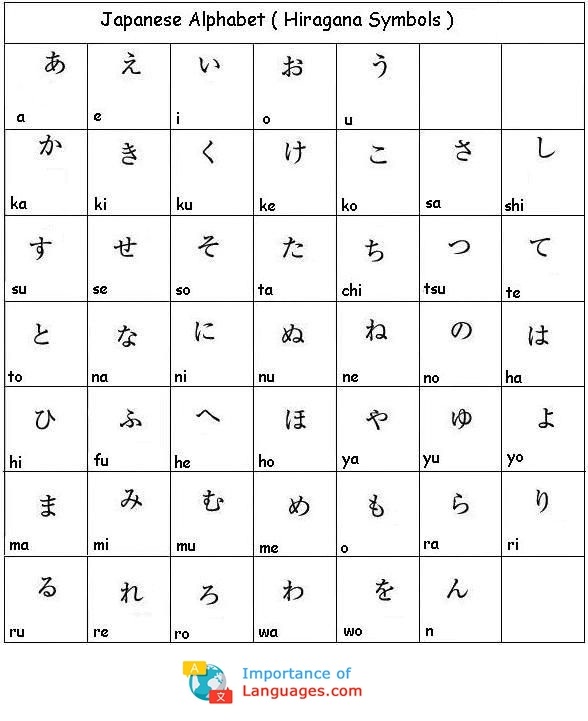
Japanese Alphabet Hiragana is a phonetic alphabet that contains 48 syllables that be sounded out to pronounce the word. Hiragana has characteristic cursive characters.
Japanese Alphabets Hiragana Symbols
When to Use Katakana Alphabet
• Foreign names and words of foreign origin.
• Foreign places
• Words of Foreign origins.
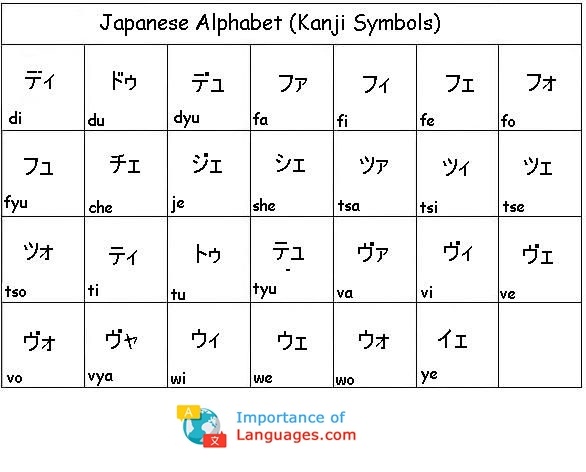
Japanese Alphabet Katakana is also a syllabic alphabet. There are 48 Katakana symbols that have similar sounds to Hiragana.
It is no coincidence that there is the same number of characters in both the Hiragana and Katakana alphabets as they both represent exactly the same sounds (some of them even look quite similar).
Japanese Alphabets Katakana Symbols
When to Use Kanji Alphabet
There is a third form of Japanese Alphabet that borrows or modifies Chinese Characters called Kanji. Kanji was borrowed from Chinese writing at a time when there was no written Japanese language and it is still around. Japanese Kanji has different meanings than Chinese characters today.
There are over 8000 Kanji. Kanji are not syllabic and are used to represent abstract concepts as well as names and everyday words. An average adult Japanese speaker must know at least 2000 off by heart. Although you don’t need to memorizes all of the Kanji. Each Kanji has several different meanings and pronunciations.
Japanese Alphabets Kanji Symbols
Japanese words are pronounced exactly as the symbols show but one thing to pay attention to is if the character has a diacritic mark above it or not.
Make sure to practice pronouncing and writing the Japanese Alphabet whenever you can. As many times as you can.
Because Japanese has three different alphabets: Hiragana, Katakana, and Kanji. Hiragana and Katakana are pretty similar with roughly 48 symbols each( some used, some not. Hiragana is for general use while Katakana is used for foreign names, the names of foreign places and words of foreign origin. Kanji are characters that are burrowed or modified from Chinese. Japanese number system is a lot easier to learn.
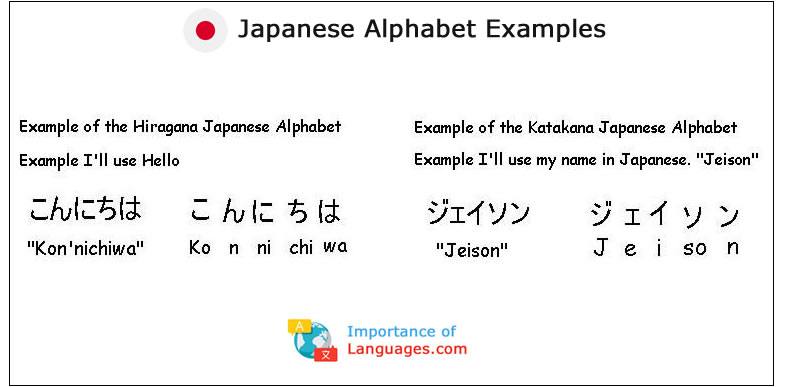
Japanese Alphabet Examples
Japanese Number System
Understanding how to write Japanese numbers should take very little time and effort to learn.
Understanding how to write Japanese numbers is really that simple to learn. Only takes an hour or two to fully memorizes the Japanese number system.
Japanese Numbers are written from Left to Right.
Japanese Numbers from 1 – 100
Japanese Numbers 1 to 100
You basically write the Japanese Characters in order. If the number is a double or triple digit number you write the Number times Position, Number times Position.
It’s actually pretty straightforward when it comes to learning how to use the Japanese number system. Pronouncing Japanese numbers is just as easy to learn.
Japanese number examples
You really just need to memorizes how to pronounce the base Japanese Numbers then you can easily pronounce any Japanese number. I personally choose to remember that Japanese numbers follow a “number-position” type pattern. Example of what I mean..
Japanese Numbers
Japanese Vocabulary and Phrases
The logical next step for Japanese beginners after learning the Japanese Alphabet would be to start developing your Japanese vocabulary with Japanese words and phrases.
Japanese Grammar
English and Japanese grammar are along the same levels when it comes to difficulty. They’re widely different, though, and a lot of your early struggles will have to do with learning all the new concepts. Most of the vocabulary will either be Japanese in origin or derived from Chinese, so there’s little chance you’ll recognize a lot of them.
The Japanese grammar rules you must follow and understand to properly speak the Japanese language.
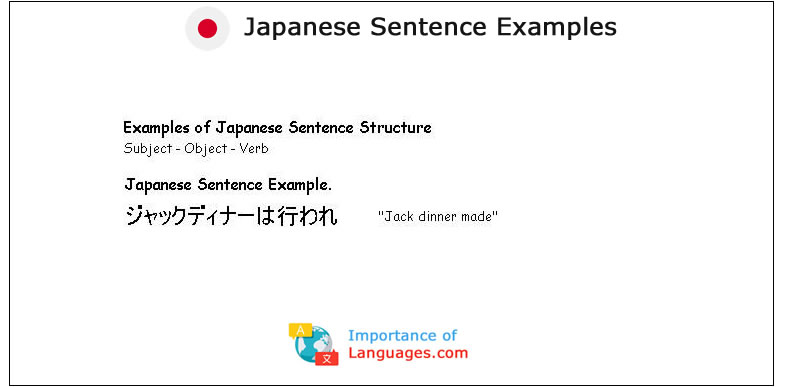
Japanese Sentence Structure is usually put the Object of the sentence ahead of the Verb/Adjective or simpified to Subject-Object-Verb.
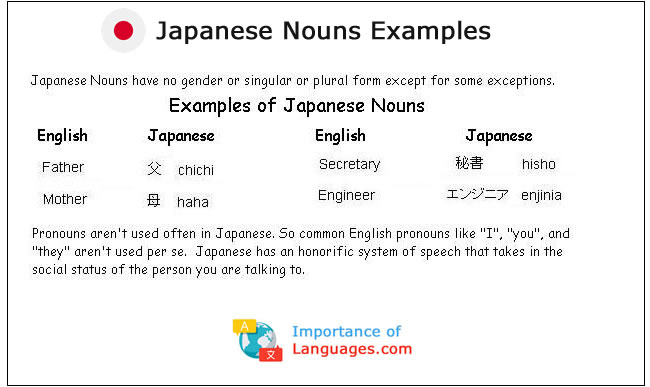
Japanese nouns don’t have any gender associated with them. Japanese pronouns are rarely or never used.
Japanese also takes into consideration the social status of the person you are speaking to.
Japanese uses more verbs then any other language and they don’t change with number, gender, or person.
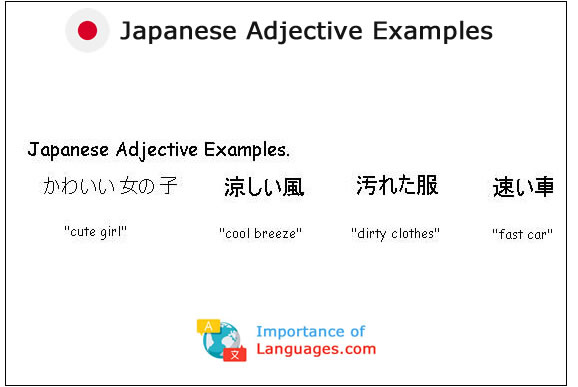
There are two types of Japanese Adjectives. They are “-i adjectives” and “-na adjectives”.
Japanese Grammar Rules
The fun part of learning any language.. Grammar!
The “rules” you must follow to properly speak a language. But don’t worry about how hard learning Japanese Grammar might feel at first. Learning Japanese grammar rules is one of the most effective ways to speed up your ability to speak a language.
Keep in mind this is just a basic introduction to understanding how Japanese grammar works
Japanese Grammar Rules: Sentence Structure
• Japanese Sentence Structure is usually put the Object of the Sentence ahead of the Verb/Adjective.
Japanese Sentence Examples
Japanese Grammar Rules: Nouns and Pronouns
Japanese Nouns Examples
• Japanese Nouns don’t have a masculine or feminine form to remember.
• The Use of Pronouns in Japanese is very limited or almost non-exist
• Japanese uses more particles and verbs to deal with the loss of pronouns.
Japanese Grammar Rules: Verbs
• The Japanese have two tenses: The simple present and the simple past.
• Verbs in Japanese grammar also do not change with number, gender or person
• Verbs are the essence of Japanese Sentences. Using more verbs then any other language.
Japanese Verb Examples
Japanese Grammar Rules: Adjectives
• There are two types of Japanese Adjectives. They are “-i adjectives” and “-na adjectives”
• “-i adjectives” are original Japanese words while -na adjectives are burrowed from other languages.
• “-i adjectives” tend to blur the line between adjectives and verbs
• “-na adjectives” modifies nouns but not predicates
Japanese Adjective Examples
Common Japanese Words
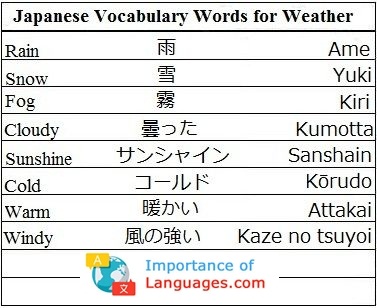
Japanese Words For Weather
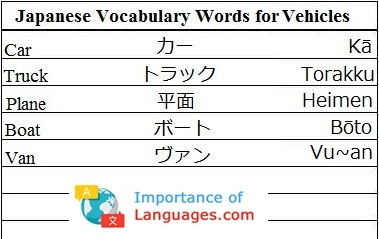
Japanese Words For Vehicles
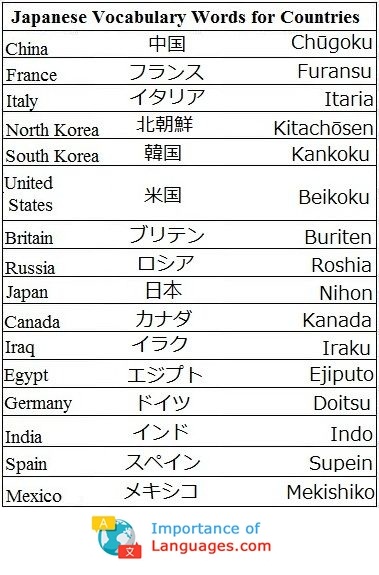
Japanese words for countries
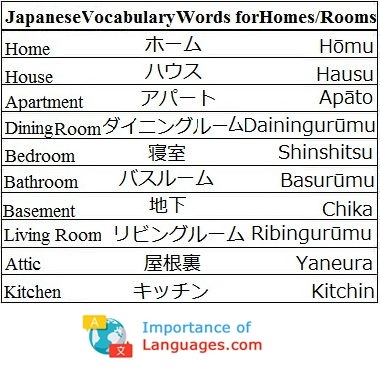
Japanese Words For Homes Rooms
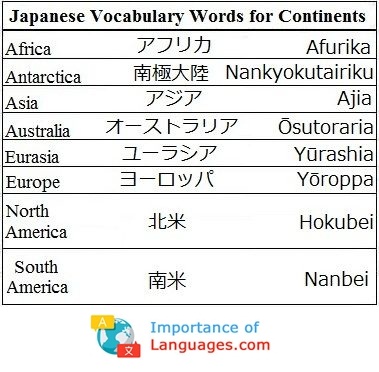
Japanese Words for Continents
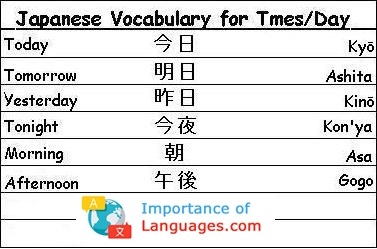
Japanese Words For Times / Day
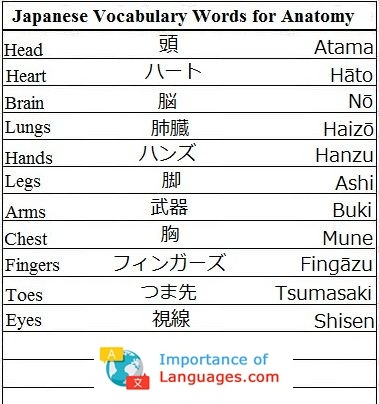
Japanese Words For Anatomy
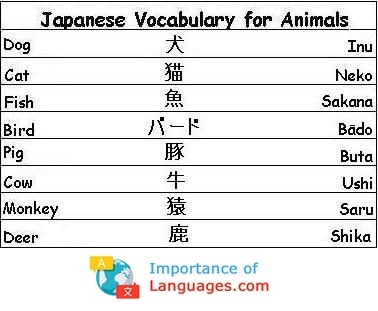
Japanese Words for Animals
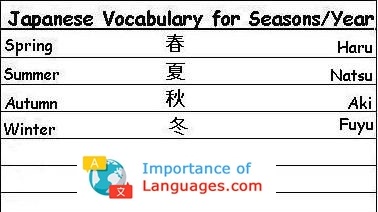
Japanese Words For Seasons / Year
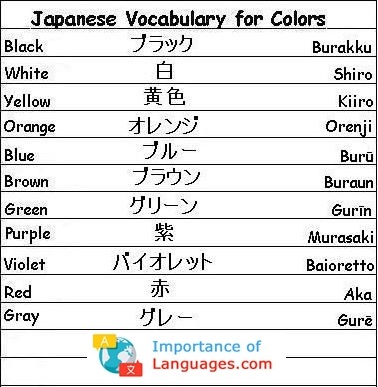
Japanese Words for Colors
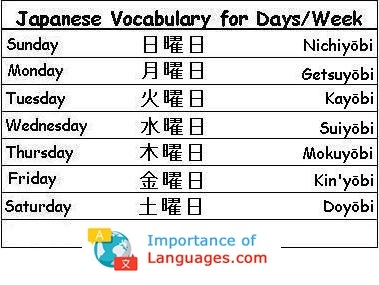
Japanese Words For Days / Week
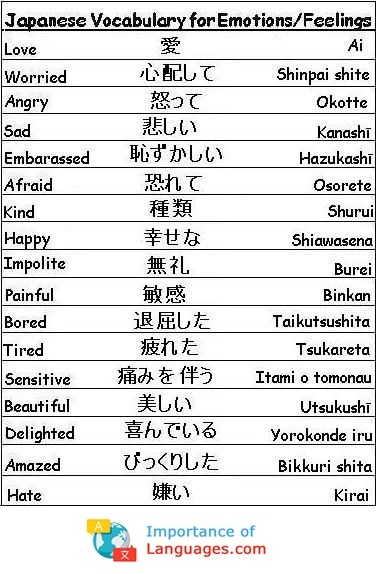
Japanese Words for Emotions Feelings
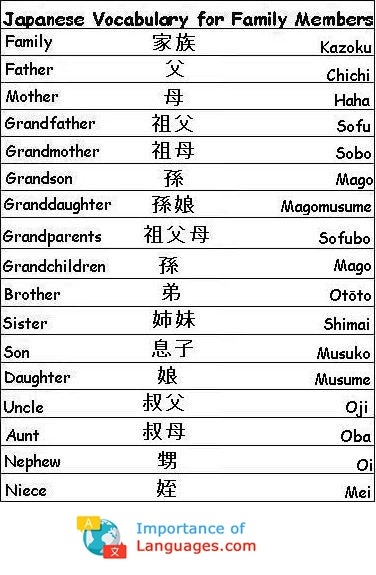
Japanese Words For Family Members
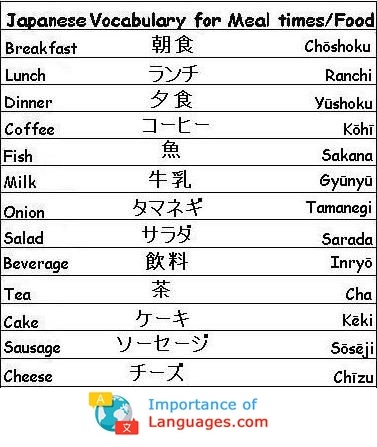
Japanese Words For Meal times Food
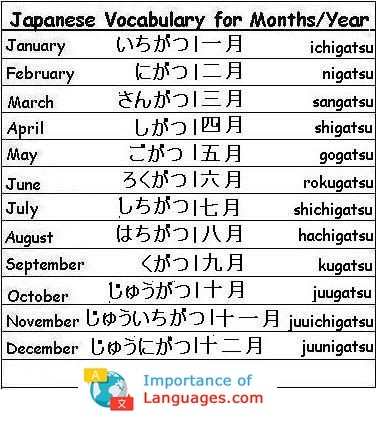
Japanese Words for Months / Years
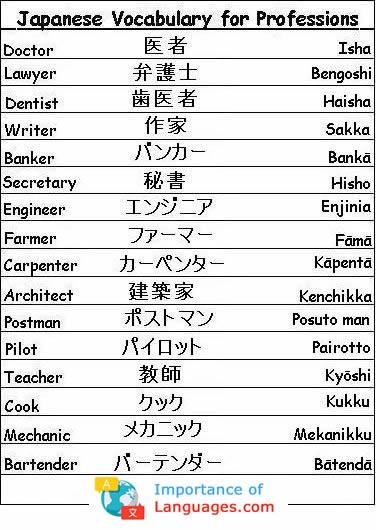
Japanese Words for Professionals
Consider Using a Japanese Language Learning Program
Try Japanese Language Software
If you are really serious about learning Japanese and want to maximize your time then you should consider using a Japanese language course to further aid you in your quest to learn Japanese.
There are several great programs out there that deliver a great language learning experience. The advantages of a language learning program in the organization and having a next step already lined up.
Most break down the lessons into 30-minute intervals that can fit into any type of schedule. Flexible to retry a lesson to make sure you understand what you are learning and give you confidence in succeeding.
Examples of great Japanese language Programs can be found below.
This guide was written for Korean Beginners that don’t know where to start learning the Korean language.
Why Learn the Korean Language
Korean is spoken by an estimated seventy-five million people in North and South Korea, and the importance of the Korean language is steadily growing all over the world. Although most speakers of Korean live on the Korean Peninsula and its adjacent islands, more than three million are scattered throughout the world on every continent.
Learning to read the Korean Alphabet should be the first stop for Korean beginners.
Korean has personally my favourite alphabet to learn because of its unique structuring and style of writing.
Korean Alphabet has 35 characters overall with 10 vowels, 14 constants, and 11 Dipthongs (Complex vowels made up of regular vowels).
Korean Alphabet Table
Learn Korean Written Alphabet is also known as Hangul alphabet or script and has origins that from Chinese. The Korean Alphabet contains ten main vowels, fourteen consonants, and eleven complex vowels(Known as Diphthongs). Until 1980, Korean was written from right to left but since then Hangul has changed direction to be written left to right. An interesting fact when you want to learn the Korean alphabet. The shapes of the consonants are based on the shape the mouth made when pronouncing the corresponding sound is made. Some consonants were created by adding extra lines to the original shapes.
Korean Diphthongs Complex Korean Vowels
Korean letters are group together in blocks or boxes to form syllables. These syllables are formed with an initial consonant, then either one or two vowels to the right of the initial constant or below the initial consonant. The consonant “ng” is silent when placed in the initial position. Example of how Korean is written and how to read Korean below.
Korean Number System
How to Write Korean Numbers
The Korean language has two frequently used Korean number systems:
Sino Korean
Native Korean.
Understanding how to write both Korean number system should take very little time and effort to learn.
To Avoid your initial confusion on when and in what situation to use which number system I put together lists in which each Korean number system applies to.
When to Use Sino-Korean
• For any number 100 or higher since Native Korean numbers only go up to 99.
• Counting any unit of time other than hours
• Measurements (kilometers, grams, liters, etc.)
• Phone numbers
• For creating the names of the months (number of month + ?)
• Money / currency
• Math
You basically write the Korean Characters in order. If the number is a double or triple digit number you write the Number times Position, Number times Position.
Korean Number Examples
It’s actually pretty straightforward when it comes to learning how to use the Sino Korean number system. Pronouncing Sino Korean numbers is just as easy to learn.
To illustrate what I mean, here is Sino Korean numbers 1 to 100.
Korean Numbers 1 to 100
When to use Native Korean
• Counting physical objects (including people) and usually followed by a count word.
• Years of age
• Hours
• Counting (in general)
• Counting months (but only when used with the native Korean word for month/moon: ?)
Native Korean Numbers are written exactly like they are written above.
It’s actually pretty straightforward when it comes to learning how to use the Native Korean number system. Pronouncing Native Korean numbers is just as easy to learn. To illustrate what I mean, here are Native Korean numbers 1 to 99.
You really just need to memorizes how to pronounce the base Native Korean Numbers then you can easily pronounce any Native Korean number. I personally choose to remember that Native Korean numbers follow a “number-position” type pattern. Example of what I mean..
Understanding how to write Korean numbers is really that simple to learn. Only takes an hour or two to fully memorizes the Korean number system.
Korean Numbers 1 to 100
You really just need to memorizes how to pronounce the base Sino Korean Numbers then you can easily pronounce any Sino Korean number. I personally choose to remember that Sino Korean numbers follow a “number-position” type pattern. Example of what I mean..
Korean Vocabulary and Korean Phrases
The logical next step for Korean beginners after learning the Korean Alphabet would be to start developing your Korean vocabulary with Korean words and phrases.
Common Korean Phrases
If you ever play to visit a country where the primary spoken language is Korean, then knowing and being able to use common Korean phrases. Even though English is gradually becoming the most used language in international business in some situations. Speaking the language of the locals and talking to the people. It shows respect and an effort to their culture with just knowing a few common Korean phrases.
In any language, you should be able to greet people and introduce yourself or simply ask for help or directions. Korean greeting and phrases to start or end conversations. Being able to introduce yourself in Korean. Being able to say your “Sorry” or ask politely for someone to repeat themselves. Common Korean words and phrases like saying “yes’ and “no”
Most of the sentences below can be used for travel and daily life conversations. So they might come handy if you memorizes and practice then. The following is a list of common Korean phrases that you may need to know in the Korean language:
I hope you find this page of common Korean phrases useful in your travels. Memorizes them and try to incorporate them into your daily conversations.
Korean Words for Vehicles
Korean Words for Weather
Korean Words for Homes & Rooms
Korean Words for Countries
Korean Words for Continents
Korean Words for Anatomy
Korean Words for Times / Days
Korean Words for Seasons / Year
Korean Words for Animals
Korean Words for Colours
Korean Words for Days Week
Korean Words for Emotions Feelings
Korean Words for Family
Korean Words for Meals
Korean Words for Months / Year
Korean Words for Professionals
Korean Grammar
The Korean grammar rules you must follow and understand to properly speak the Korean language.
Korean Sentence follows the pattern of Subject + Object + Verb but politeness and respect to seniority also play an important part in the Korean language and culture.
Korean Nouns do not have a Gender.
Korean Nouns can be made plural by adding “들” to the end of the word.
Korean Verbs rely on several factors such as tense, aspect, mood, and the social relation to the people you are referring and speaking to.
More information about Korean grammar can be found below.
Korean Grammar Rules
The challenging or confusing part of learning any language.. learning Korean Grammar Rules! The rules you must follow to properly speak the Korean language. But don’t worry about how hard learning Korean Grammar might feel at first. Learning Korean grammar rules is one of the most effective ways to speed up your ability to properly speak the Korean language. Keep in mind this is just a basic introduction to understanding how Korean grammar works.
Korean Grammar Rules: Sentence Structure
• In Korean, the order of the words in a sentence is subject + object + verb.
• Politeness and respect to seniority is a critical part of Korean culture and the Korean Language.
Examples of Korean Sentence
Korean Grammar Rules: Nouns and Pronouns
• Korean Nouns do not have a Gender. Korean Nouns can be made a plural by adding “?”
• Korean Pronouns have honorifics to show respect formally or informally.
Korean Nouns
Korean Grammar Rules: Verbs
• Korean Verbs uses three tenses: past, present, and future
• Verbs can change according to the age and/or seniority to the person your speaking to.
• Korean Verbs rely on several factors such as tense, aspect, mood, and the social relation to the people you are referring and speaking to.
Korean Verb Examples
Korean Grammar Rules: Adjectives
• Korean Adjectives are words that describe or modify another person or thing in the sentence
Learning Korean grammar rules can be considered the cornerstone of the language and will take some time to learn but creates a sturdy foundation to help you completely learn Korean in no time. Take the time to let these points soak in, then build on them as you continue your Korean studies. Good luck, and have fun learning Korean.
Korean Adjective Examples
Consider Using a Korean Language Learning Program
Try Korean Language Software
If you’re really serious about learning Korean and want to maximize your time then you should consider using a Korean language course to further aid you in your quest to learn Korean. There are several great programs out there that deliver a great language learning experience. The advantages of a language learning program are the organization and having the next step already lined up. Most break down the lessons into 30-minute intervals that can fit into any type of schedule. Flexible to retry a lesson to make sure you understand what you are learning and give you confidence in succeeding.
Examples of great Korean language programs can be found below.
This guide was written for Chinese Beginners that don’t know where to start learning Mandarin Chinese.
Why Learn Chinese?
Mandarin Chinese is currently ranked first as the most spoken language in the world with nearly an estimated billion speakers in China, Taiwan, and other parts of the world.
The most spoken Chinese dialect is the Mandarin dialect, which is understood by the vast majority of Chinese Speakers.
Actually learning Chinese and able to speak Chinese isn’t very hard. A few tips below will help improve your Chinese skills step by step.
– You need to find a motive why you want to learn Chinese, and how long, how often you speak Chinese? E.g. : My colleague wanted to be a part time translator so he signed up for a Chinese course. My student had a Chinese girl friend and wanted to communicate with her and her parent in Asia. It all depends what motivates you to learn Chinese and always remember your motive.
– Use 20 minutes a day, to learn new words and practice the previous chapter, pronounce it out loud so you’ll remember them.
– Find a local group, or friends who are able to speak Chinese, go out with them more often and learn from them. You need a partner so you can improve your oral skills.
– Learn to speak and understand Chinese is easy, but writing and pronounce it accurately would be the harder part.
– There’s no faster way to master Chinese Language, because it has totally no connection with French, Italian or Spanish. Chinese characters itself has more than 3000 kinds of it and each has its own meaning. Combining 2 character will form another meaning. If you wan to master Chinese language, go to the resource box below and you can find how to master them well.
Chinese Language Learning Tips
Actually learning Chinese and able to speak Chinese isn’t very hard. A few tips below will help improve your Chinese skills step by step.
– You need to find a motive why you want to learn Chinese, and how long, how often you speak Chinese? E.g. : My colleague wanted to be a part time translator so he signed up for a Chinese course. My student had a Chinese girl friend and wanted to communicate with her and her parent in Asia. It all depends what motivates you to learn Chinese and always remember your motive.
– Use 20 minutes a day, to learn new words and practice the previous chapter, pronounce it out loud so you’ll remember them.
– Find a local group, or friends who are able to speak Chinese, go out with them more often and learn from them. You need a partner so you can improve your oral skills.
– Learn to speak and understand Chinese is easy, but writing and pronounce it accurately would be the harder part.
– There’s no faster way to master Chinese Language, because it has totally no connection with French, Italian or Spanish. Chinese characters itself has more than 3000 kinds of it and each has its own meaning. Combining 2 character will form another meaning.
Chinese Alphabet
Learning to read the Chinese Alphabet should be the first stop for Chinese beginners. It’s important to understand that there isn’t exactly a Chinese alphabet. Chinese uses Chinese characters to represent ideas.
Chinese Numbers
Understanding how to write Chinese numbers should take very little time and effort to learn.
Chinese numbers are written from Left to Right like English numbers.
Although the Chinese symbol for zero appears above, it’s only used when it comes to money.
You write the base Chinese Number then what I call a “multiplier” if the number is above ten. Here are a couple of examples to demonstrate what I mean.
It’s actually pretty straightforward when it comes to learning how to use the Chinese number system. Pronouncing Chinese straightforward easier. Because they follow the exact same pattern in the above example.
To illustrate what I mean, here are Chinese numbers 1 to 100.
Chinese numbers 1 to 100
You really just need to memorize how to pronounce the base Chinese Numbers then you can easily pronounce any Chinese number. I personally choose to remember that Chinese numbers follow a “number-position” type pattern. Example of what I mean..
Understanding how to write Chinese numbers is really that easy to learn. Should only take you an hour or two to fully memorizes the Chinese number system.
Chinese Vocabulary and Phrases
The logical next step after learning the Chinese Alphabet for Chinese beginners would be to start developing your Chinese vocabulary with Chinese words and phrases. I put together two posts of Chinese vocabulary and one post of Chinese phrases for Chinese beginners to start building their knowledge of Chinese Words and Phrases.
Chinese Grammar
The Chinese grammar rules you must follow and understand to properly speak the Chinese language.
Learning to understand Mandarin Chinese sentence structure isn’t simple to grasp.
To narrow it down you can say it follows a Subject-Verb-Object pattern. Chinese nouns have formal and informal ways of speaking and writing nouns and pronouns. Context plays a major role in figuring out what tense Chinese Verbs refer to. Two or more verbs can stack in Chinese Grammar, as Verbal complements(after the main verb) or as coverbs(before the main verb).
Because Chinese doesn’t have a real alphabet in the standard sense. Chinese Pinyin is a system used to teach Chinese Characters into romanized Latin script that means “spelled sound”. Each Syllable is made up of Sheng and a yun. Sheng is the consonant that begins the syllable• Yun follows the Sheng and is usually a vowel sound. It’ll take a while to learn Chinese Characters since there are more than four hundred exist in the Chinese language. And that doesn’t count the various tonal variations. The overall total of possible combinations leaves Mandarin Chinese with total of 1600(400 base combinations characters with 4 tones each) unique syllables.
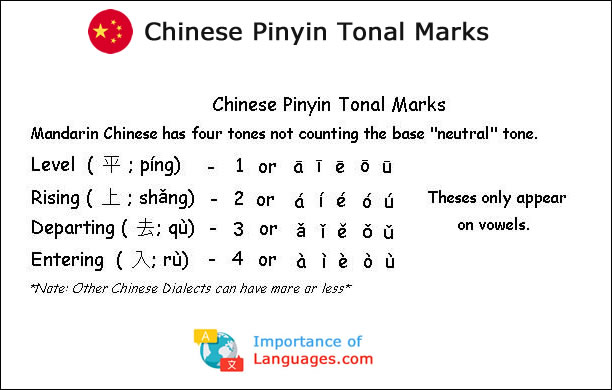
The standard Chinese dialect of Mandarin Chinese has four tonal marks that radically change the meaning of the word and crucial when you learn Chinese Pinyin. Theses are indicated by marks over the vowels or by using numbers along with the Chinese Pinyin.
Chinese Pinyin Tonal Marks
Pronouncing Chinese Tones Level – This tone is pronounced high and level. Almost monotone. Rising – This tone has a increase in pitch. Departing – This tone sounds like it’s “dipping”. Falls and Rises again. Entering – This tone starts out high then drops in tone.
When trying to learn Chinese Pinyin. You must pay attention to Tonal marks because they can change the word from one meaning to a whole completely different meaning. Example of how changing the tonal marks changes the meaning of the Chinese Character.
I put together a directory for you to start to learn Chinese Pinyin characters. Sorted by tone alphabetically. I also split “c”, “s”, and “z” each into separate pages to cut down on the size of the images and make it more organized.
Learn Chinese Pinyin is extremely important when it comes to learning to write and read Chinese Characters. So make sure to practice pronouncing and writing Chinese Pinyin whenever you can. As many times as you can.
Chinese Grammar Rules
The fun part of learning any language.. learning Chinese grammar rules! The rules you must follow to properly speak the Chinese language. But don’t worry about how hard learning Chinese Grammar might feel at first. Learning Chinese grammar rules is one of the most effective ways to speed up your ability to speak the Chinese language. Keep in mind this is just a basic introduction to understanding how Chinese grammar works.
Chinese Grammar Rules: Sentence Structure
• A lot of learning how to speak Mandarin is encoded in learning Chinese sentence structure. Some state Mandarin Chinese grammar is simple but it’s really not.
Chinese Sentence Structure
Chinese Grammar Rules: Nouns and Pronouns
Chinese Noun Examples
• Context is the only way to tell if a Chinese Noun is singular or plural. • Chinese has single pronunciations for common pronouns such as “he”, “she”, or “it”. • The context of the sentence is very important when figuring out the “gender” in which the pronoun or noun is referring to. • Chinese nouns have formal and informal ways of speaking and writing them.
Chinese Grammar Rules: Verbs
• Chinese Verbs have no tense. Verbs only have one form regardless of the time it’s performed. • To indicate the time of the action such as “yesterday”, “today” and “tomorrow”. The words are added either before or after the subject. • Conjugating and irregular have no part in Chinese. • Two or more verbs can stack in Chinese Grammar, as Verbal complements(after the main verb) or as coverbs(before the main verb)
Chinese Grammar Rules: Adjectives
Chinese Adjective Examples
• An adverb and an adjective in combination are ordinarily treated as a phrase and written as two units. Some adverb + adjective constructions, however, undergo a change in meaning so that they express a single concept rather than two independent concepts; such transformed adverb + adjective constructions are considered single words and written as single units.
Learning Chinese grammar rules can be considered the cornerstone of the language and will take some time to learn but creates a sturdy foundation to help you completely learn Chinese in no time. Take the time to let these points soak in, then build on them as you continue your Chinese studies. Good luck, and have fun learning Chinese
Chinese vocabulary lists to help start you on your way to learning Chinese vocabulary.
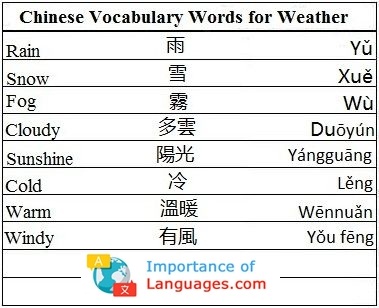
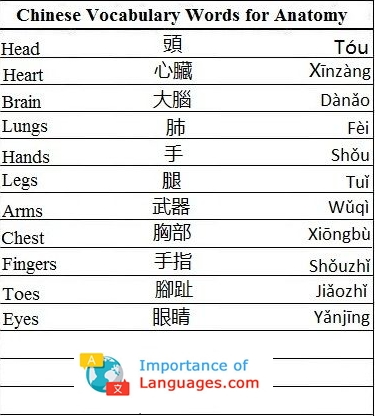
Your Chinese vocabulary should begin with words you could use in your daily life and should be familiar with already. Below are some useful Chinese vocabulary and expressions for Continents, Weather, Anatomy, Home/Rooms, Vehicles, and Countries from around the world.
Depending on where you live. You are taught a little differently when it comes to continents, if you’re an American like me, you were taught 7 continents. In parts of Europe, some are taught 5-6 continents instead. Either merging Europe and Asia as Eurasia and combining North and South America as one continent.
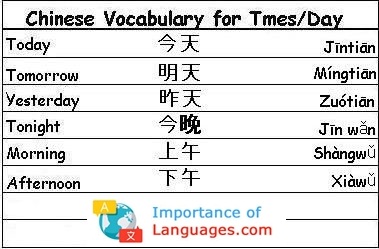
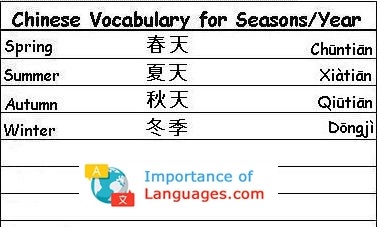
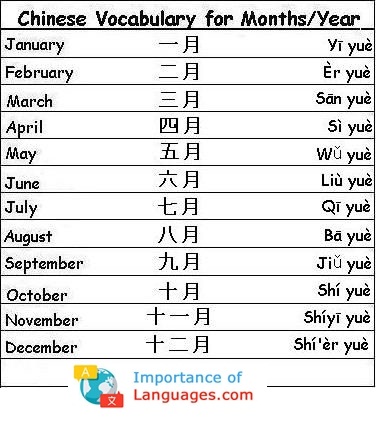
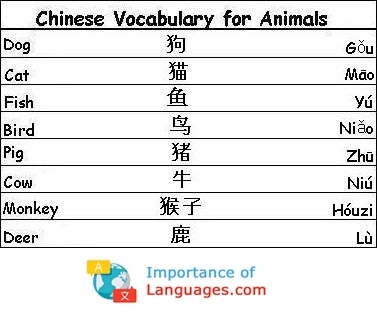
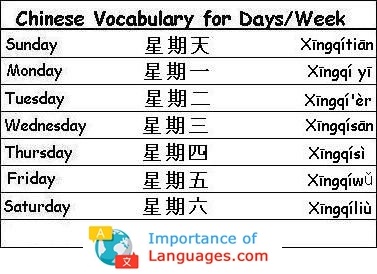
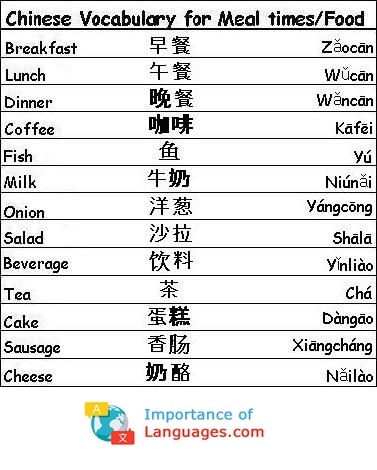
Chinese Words for Home / RoomsChinese Words for WeatherChinese Words for AnatomyChinese Words for Times / DayChinese Words for Seasons / YearsChinese Words for ProfessionsChinese Words for Months / YearsChinese Words for AnimalsChinese Words for ColoursChinese Words for Days WeekChinese Words for FamilyChinese Words for Meal Times Food
Consider Using a Language Learning Program
Try Language Software
If you are really serious about learning Chinese and want to maximize your time then you should consider using a Chinese language course to further aid you in your quest to learn French. There are several great programs out there that deliver a great language learning experience. The advantages of a language learning program is the organization and having a next step already lined up. Most break down the lessons into 30-minute intervals that can fit into any type of schedule. Flexible to retry a lesson to make sure you understand what you are learning and give you confidence in succeeding.
Examples of great Chinese language programs can be found below.
This guide was written for Chinese Beginners that don’t know where to start learning Mandarin Chinese.
Why Learn Chinese?
Mandarin Chinese is currently ranked first as the most spoken language in the world with nearly an estimated billion speakers in China, Taiwan, and other parts of the world.
The most spoken Chinese dialect is the Mandarin dialect, which is understood by the vast majority of Chinese Speakers.
Chinese Beginners Guide Menu
So how to start learning Chinese?
Actually learning Chinese and able to speak Chinese isn’t very hard. A few tips below will help improve your Chinese skills step by step.
– You need to find a motive why you want to learn Chinese, and how long, how often you speak Chinese? E.g. : My colleague wanted to be a part time translator so he signed up for a Chinese course. My student had a Chinese girl friend and wanted to communicate with her and her parent in Asia. It all depends what motivates you to learn Chinese and always remember your motive.
– Use 20 minutes a day, to learn new words and practice the previous chapter, pronounce it out loud so you’ll remember them.
– Find a local group, or friends who are able to speak Chinese, go out with them more often and learn from them. You need a partner so you can improve your oral skills.
– Learn to speak and understand Chinese is easy, but writing and pronounce it accurately would be the harder part.
– There’s no faster way to master Chinese Language, because it has totally no connection with French, Italian or Spanish. Chinese characters itself has more than 3000 kinds of it and each has its own meaning. Combining 2 character will form another meaning. If you wan to master Chinese language, go to the resource box below and you can find how to master them well.
Chinese Language Learning Tips
Actually learning Chinese and able to speak Chinese isn’t very hard. A few tips below will help improve your Chinese skills step by step.
– You need to find a motive why you want to learn Chinese, and how long, how often you speak Chinese? E.g. : My colleague wanted to be a part time translator so he signed up for a Chinese course. My student had a Chinese girl friend and wanted to communicate with her and her parent in Asia. It all depends what motivates you to learn Chinese and always remember your motive.
– Use 20 minutes a day, to learn new words and practice the previous chapter, pronounce it out loud so you’ll remember them.
– Find a local group, or friends who are able to speak Chinese, go out with them more often and learn from them. You need a partner so you can improve your oral skills.
– Learn to speak and understand Chinese is easy, but writing and pronounce it accurately would be the harder part.
– There’s no faster way to master Chinese Language, because it has totally no connection with French, Italian or Spanish. Chinese characters itself has more than 3000 kinds of it and each has its own meaning. Combining 2 character will form another meaning.
Chinese Alphabet
Learning to read the Chinese Alphabet should be the first stop for Chinese beginners. It’s important to understand that there isn’t exactly a Chinese alphabet. Chinese uses Chinese characters to represent ideas.
Chinese Numbers
Understanding how to write Chinese numbers should take very little time and effort to learn.
Chinese numbers are written from Left to Right like English numbers.
Although the Chinese symbol for zero appears above, it’s only used when it comes to money.
You write the base Chinese Number then what I call a “multiplier” if the number is above ten. Here are a couple of examples to demonstrate what I mean.
It’s actually pretty straightforward when it comes to learning how to use the Chinese number system. Pronouncing Chinese straightforward easier. Because they follow the exact same pattern in the above example.
To illustrate what I mean, here are Chinese numbers 1 to 100.
Chinese numbers 1 to 100
You really just need to memorize how to pronounce the base Chinese Numbers then you can easily pronounce any Chinese number. I personally choose to remember that Chinese numbers follow a “number-position” type pattern. Example of what I mean..
Understanding how to write Chinese numbers is really that easy to learn. Should only take you an hour or two to fully memorizes the Chinese number system.
Chinese Vocabulary and Phrases
The logical next step after learning the Chinese Alphabet for Chinese beginners would be to start developing your Chinese vocabulary with Chinese words and phrases. I put together two posts of Chinese vocabulary and one post of Chinese phrases for Chinese beginners to start building their knowledge of Chinese Words and Phrases.
Chinese Grammar
The Chinese grammar rules you must follow and understand to properly speak the Chinese language.
Learning to understand Mandarin Chinese sentence structure isn’t simple to grasp.
To narrow it down you can say it follows a Subject-Verb-Object pattern. Chinese nouns have formal and informal ways of speaking and writing nouns and pronouns. Context plays a major role in figuring out what tense Chinese Verbs refer to. Two or more verbs can stack in Chinese Grammar, as Verbal complements(after the main verb) or as coverbs(before the main verb).
Because Chinese doesn’t have a real alphabet in the standard sense. Chinese Pinyin is a system used to teach Chinese Characters into romanized Latin script that means “spelled sound”. Each Syllable is made up of Sheng and a yun. Sheng is the consonant that begins the syllable• Yun follows the Sheng and is usually a vowel sound. It’ll take a while to learn Chinese Characters since there are more than four hundred exist in the Chinese language. And that doesn’t count the various tonal variations. The overall total of possible combinations leaves Mandarin Chinese with total of 1600(400 base combinations characters with 4 tones each) unique syllables.
The standard Chinese dialect of Mandarin Chinese has four tonal marks that radically change the meaning of the word and crucial when you learn Chinese Pinyin. Theses are indicated by marks over the vowels or by using numbers along with the Chinese Pinyin.
Chinese Pinyin Tonal Marks
Pronouncing Chinese Tones Level – This tone is pronounced high and level. Almost monotone. Rising – This tone has a increase in pitch. Departing – This tone sounds like it’s “dipping”. Falls and Rises again. Entering – This tone starts out high then drops in tone.
When trying to learn Chinese Pinyin. You must pay attention to Tonal marks because they can change the word from one meaning to a whole completely different meaning. Example of how changing the tonal marks changes the meaning of the Chinese Character.
I put together a directory for you to start to learn Chinese Pinyin characters. Sorted by tone alphabetically. I also split “c”, “s”, and “z” each into separate pages to cut down on the size of the images and make it more organized.
Learn Chinese Pinyin is extremely important when it comes to learning to write and read Chinese Characters. So make sure to practice pronouncing and writing Chinese Pinyin whenever you can. As many times as you can.
Chinese Grammar Rules
The fun part of learning any language.. learning Chinese grammar rules! The rules you must follow to properly speak the Chinese language. But don’t worry about how hard learning Chinese Grammar might feel at first. Learning Chinese grammar rules is one of the most effective ways to speed up your ability to speak the Chinese language. Keep in mind this is just a basic introduction to understanding how Chinese grammar works.
Chinese Grammar Rules: Sentence Structure
• A lot of learning how to speak Mandarin is encoded in learning Chinese sentence structure. Some state Mandarin Chinese grammar is simple but it’s really not.
Chinese Sentence Structure
Chinese Grammar Rules: Nouns and Pronouns
Chinese Noun Examples
• Context is the only way to tell if a Chinese Noun is singular or plural. • Chinese has single pronunciations for common pronouns such as “he”, “she”, or “it”. • The context of the sentence is very important when figuring out the “gender” in which the pronoun or noun is referring to. • Chinese nouns have formal and informal ways of speaking and writing them.
Chinese Grammar Rules: Verbs
• Chinese Verbs have no tense. Verbs only have one form regardless of the time it’s performed. • To indicate the time of the action such as “yesterday”, “today” and “tomorrow”. The words are added either before or after the subject. • Conjugating and irregular have no part in Chinese. • Two or more verbs can stack in Chinese Grammar, as Verbal complements(after the main verb) or as coverbs(before the main verb)
Chinese Grammar Rules: Adjectives
Chinese Adjective Examples
• An adverb and an adjective in combination are ordinarily treated as a phrase and written as two units. Some adverb + adjective constructions, however, undergo a change in meaning so that they express a single concept rather than two independent concepts; such transformed adverb + adjective constructions are considered single words and written as single units.
Learning Chinese grammar rules can be considered the cornerstone of the language and will take some time to learn but creates a sturdy foundation to help you completely learn Chinese in no time. Take the time to let these points soak in, then build on them as you continue your Chinese studies. Good luck, and have fun learning Chinese
Chinese vocabulary lists to help start you on your way to learning Chinese vocabulary.
Your Chinese vocabulary should begin with words you could use in your daily life and should be familiar with already. Below are some useful Chinese vocabulary and expressions for Continents, Weather, Anatomy, Home/Rooms, Vehicles, and Countries from around the world.
Depending on where you live. You are taught a little differently when it comes to continents, if you’re an American like me, you were taught 7 continents. In parts of Europe, some are taught 5-6 continents instead. Either merging Europe and Asia as Eurasia and combining North and South America as one continent.
Chinese Words for Home / RoomsChinese Words for Weather
Chinese Words for Anatomy
Chinese Words for Times / Day
Chinese Words for Seasons / Years
Chinese Words for Professions
Chinese Words for Months / Years
Chinese Words for Animals
Chinese Words for Colours
Chinese Words for Days Week
Chinese Words for Family
Chinese Words for Meal Times Food
Consider Using a Language Learning Program
Try Language Software
If you are really serious about learning Chinese and want to maximize your time then you should consider using a Chinese language course to further aid you in your quest to learn French. There are several great programs out there that deliver a great language learning experience. The advantages of a language learning program are the organization and having a next step already lined up. Most break down the lessons into 30-minute intervals that can fit into any type of schedule.
Flexible to retry a lesson to make sure you understand what you are learning and give you confidence in succeeding.
A web-application developed by the University of Cambridge Language Centre for basic level students of Chinese. It focuses on listening and reading skill but it also includes many activities that help learners prepare for speaking and writing. Note that you can also download Intermediate Chinese here.
Designed to give a practical command of spoken standard Chinese with nine situational modules. Each module consists of tapes (MP3), a student textbook (PDF), and a workbook. In addition to the core modules, there is a resource module and eight optional modules.
Grammar and vocabulary to beginners, offering guidance in pronunciation and language fundamentals.
Learn Chinese on Spotify – Spotify
A collection of audio courses on Spotify, that will take you from beginner lessons to advanced conversations–featuring essential travel phrases and vocabulary.
This guide was written for Hindi Beginners that don’t know where to start learning the Hindi language.
[su_quote]The Hindi language is the second most spoken language in the world after Mandarin Chinese.[/su_quote]
It’s estimated that nearly half a billion people worldwide speak this wonderful language. Hindi is one of many languages in India but is considered to be the national and official language of India. The Hindi language is also known as Hindi-Urdu or Hindustani language.
The Hindi alphabet is also known as the Devanagari alphabet and contains 48 characters.
Hindi contains 10 vowels, 2 symbols, 36 constants, and has no upper and lower case of each letter.
Hindi letters are written left to right and linked together by lines through the top of each letter
Hindi Alphabet is also known as the Devanagari Alphabet or script that is used to write Hindi, Marathi, and Nepali. Since the 19th century, it has been the most commonly-used script for Sanskrit and Pali. Devanagari is also employed for Gujari, Bhili, Bhojpuri, Konkani, Magahi, Maithili, Marwari, Newari, Pahari (Garhwali and Kumaoni), Santhali, Tharu, and sometimes Sindhi, Panjabi, and Kashmiri.
Hindi Alphabet letters are written in a cursive shape and is recognizable by a distinctive horizontal line running along the tops of the letters that links them together. Plus they don’t have a no uppercase or lowercase version of each letter. The Hindi Alphabet consists of ten vowels and thirty-six consonants and is written left to right and linked together by the lines through the top of the letters.
The Hindi Alphabet is a phonetic alphabet which means each Hindi character is pronounced. Hindi consonants carry an inherent vowel which can be altered or muted by means of diacritics or mantra.
hindi alphabet guide
Hindi Number System
When you write the numbers, again, they go from left to right, like English words and numbers, but opposite for the Hindi language.
Pronouncing Hindi numbers on the other hands get very tricky. Hindi numbers 1 to 10 should be your primary focus when you begin.
Hindi Vocabulary Numbers
Hindi Grammar Rules
Hindi sentence structure can be confusing at times but generally tend to follow a Subject-Object-Verb pattern.
Hindi nouns have genders: Masculine and Feminine.
Masculine usually ending in a and Feminine usually ending in “i” or “iya”.
Hindi Verbs usually follow the object of the sentence and can have past, present, or future tenses.
Hindi adjective changes according to the gender of the word they are modifying. More information about Hindi grammar can be found below
Hindi Grammar Rules: Sentence Structure
• Hindi uses the sentence structure of subject then object then verb.
Hindi Grammar Rules: Nouns And Pronouns
• Hindi Nouns have a Gender, Masculine or Feminine
• There are no Definite or Indefinite articles in Hindi
• Singular and plural nouns usually aren’t always distinguishable.
Hindi Masculine / Feminine Examples
Hindi Grammar Rules: Verbs
• Hindi Verbs usually follow the object of the sentence
• Hindi Verbs do have a tense to them. Past, Present, or Future.
• Hindi Verbs can also be either habitual, accelerating or perfective.
Hindi verb examples
Hindi Grammar Rules: Adjectives
• Hindi Adjective change according to Word Gender.
Hindi Adjective Examples
Common Hindi Words
Basic hindi words
hindi words for meals
hindi words for emotions
hindi words for families
hindi words for countries
hindi words for colors
hindi words for months years
hindi words for animals
hindi words for weather
hindi words for days weeks
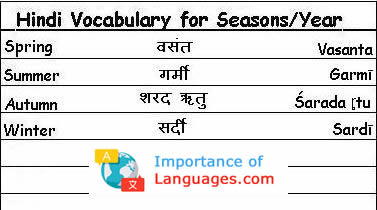
hindi words for seasons year
hindi words for times / days
Consider Using a Hindi Language Learning Program
If you are really serious about learning Hindi and want to maximize your time then you should consider using a Hindi language course to further aid you in your quest to learn Hindi.
There are several great programs out there that deliver a great language learning experience. The advantages of a language learning program are the organization and having the next step already lined up. Most break down the lessons into 30-minute intervals that can fit into any type of schedule. Flexible to retry a lesson to make sure you understand what you are learning and give you confidence in succeeding.
Examples of great Hindi Language Programs can be found below: