Categories
Learn Chinese Language

Learn Chinese Pinyin Characters – Learn Chinese Pinyin Tones

Because Chinese doesn’t have a real alphabet in the standard sense. Chinese Pinyin is a system used to teach Chinese Characters into romanized Latin script that means “spelled sound”. Each Syllable is made up of Sheng and a yun. Sheng is the consonant that begins the syllable• Yun follows the Sheng and is usually a vowel sound. It’ll take a while to learn Chinese Characters since there are more than four hundred exist in the Chinese language. And that doesn’t count the various tonal variations. The overall total of possible combinations leaves Mandarin Chinese with total of 1600(400 base combinations characters with 4 tones each) unique syllables.

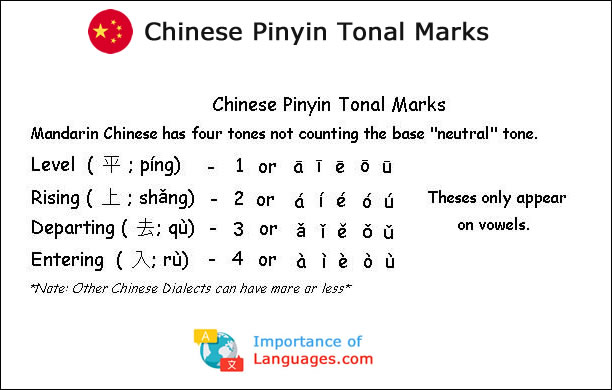
The standard Chinese dialect of Mandarin Chinese has four tonal marks that radically change the meaning of the word and crucial when you learn Chinese Pinyin. Theses are indicated by marks over the vowels or by using numbers along with the Chinese Pinyin.

Pronouncing Chinese Tones
Level – This tone is pronounced high and level. Almost monotone.
Rising – This tone has a increase in pitch.
Departing – This tone sounds like it’s “dipping”. Falls and Rises again.
Entering – This tone starts out high then drops in tone.

Chinese Pinyin Tonal Marks

When trying to learn Chinese Pinyin. You must pay attention to Tonal marks because they can change the word from one meaning to a whole completely different meaning. Example of how changing the tonal marks changes the meaning of the Chinese Character.

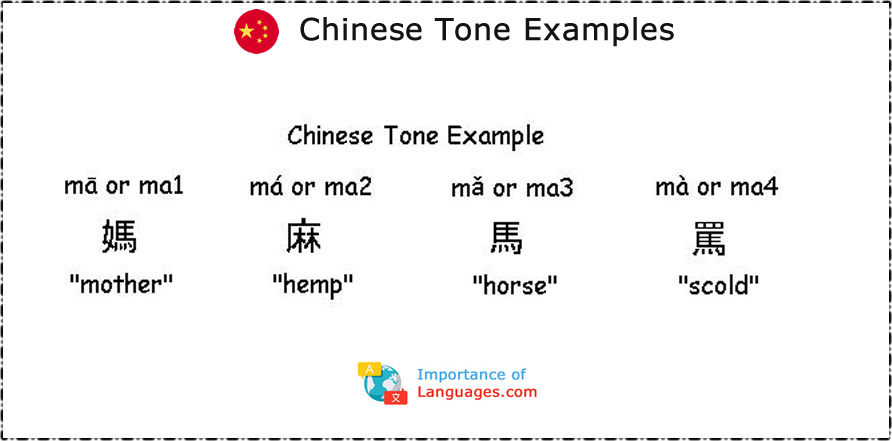
Chinese Tone Examples

I put together a directory for you to start to learn Chinese Pinyin characters. Sorted by tone alphabetically. I also split “c”, “s”, and “z” each into separate pages to cut down on the size of the images and make it more organized.

Learn Chinese Pinyin is extremely important when it comes to learning to write and read Chinese Characters. So make sure to practice pronouncing and writing Chinese Pinyin whenever you can. As many times as you can.


Three Ways To Make Learning Chinese Script Easier

Learning Chinese script isn’t the easiest thing in the world. Having had friends who studied Chinese, in fact, I know it’s a downright challenge.

The difficult thing about Chinese script is it consists of a multitude of complex characters, each of which represents a unique combination of sound and meaning. Know how you only need to memorize 24 letters of the alphabet and 10 numeric digits to read an English book with some amount of competency? With Chinese, you need to commit a minimum of 4,000 hanzi characters to memory to read Modern Standard Chinese.

Here are a few ways to help ease the learning process:

  1. Learn what the individual character components represent. Most Chinese characters are made up of components that stand for either physical things or abstract concepts. Learning what each of those components stand for can help you memorize and identify characters much easier.
  2. Use flash cards to help you memorize. On one side of each card, write the Chinese character. On the other, write its pronunciation, meaning and a sample word that uses it. Check these flash cards regularly — you’ll need plenty of work to get to that 4,000 minimum.
  3. Keep notes. On your journal, write down new characters and components you encounter, along with their meaning. This should make it easier to see patterns, allowing you to competently guess the meaning of new characters you come across.

Interested in further study into Chinese or confused on where to start? I recommend reading our Chinese Beginners Guide 

Categories
Learn Arabic Language

Learn Arabic Swear Words – List of Arabic Swear Words

I was a little hesitant to write this article because some people might be offended and such.. but actually it was one of the most requested things I receive in my email. It comes as no surprise really, since I’m sure most most of us would admit that we always seek out the profanity when learning a new language.

Learning Arabic swear words for a variety of reasons. Most people tend to swear when they are stressed or angry. If you have a relative that knows a second language then get upset and start talking in their other language? People also tend to swear when they are hurt in some way. Studies have shown that swearing does have pain reducing element.

Arabic Swear Words

Remember there is a time and place for using theses Arabic Swear Words. So only use these Arabic Swear words when it’s appropriate.

Learn more about the Arabic Language

Categories
Learn Arabic Language

Arabic Number System – How Arabic Language Numbers Work?

Understanding how to write the Arabic number system takes very little time and effort to learn. By the end of this article you should have a very solid understanding of the Arabic number system. When you write Arabic numbers, they go from left to right, like English words and numbers, but opposite for the Arabic language. Here are some examples of how to write Arabic Numbers.

Arabic Numbers

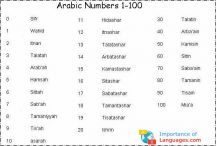
It’s actually pretty straight forward when it comes to learning how to use the Arabic number system. Pronouncing Arabic numbers on the other hands get a little bit tricky. Arabic numbers 1 to 10 should be your primary focus when you begin. Arabic numbers after gain a suffix added to the base number. To illustrate what I mean, here are Arabic numbers 1 to 100.

arabic numbers 1-100

Arabic Numbers beginning at ten through nineteen gain the suffix “tashar” added to the base number. Arabic numbers from 13-19 work like this. However the number twenty adds wa- to the mix. So it goes base number + wa- + the appropriate suffix. Example of how to write the pronunciation of Arabic numbers below.

Arabic Numbers Pronunciation

Understanding how to write Arabic numbers is really that simple to learn. Only takes an hour or two to fully memorizes the Arabic number system.


Learn more about the Arabic Language

Categories
Learn Arabic Language

Arabic Grammar Introduction – Arabic Grammar Rules

Introduction to Arabic Grammar Rules

The fun part of learning any language.. learning Arabic grammar rules! The Arabic grammar rules you must follow and understand to properly speak the Arabic language. But fear not, understanding Arabic grammar is one of the most effective ways to speed up your ability to speak the language. Keep in mind this is just a basic introduction into understanding Arabic grammar.

By now you should already know that Arabic is read from right to left unlike other languages.


Arabic Sentence Structure

Arabic has two style of sentences. Nominal and Verbal.

  • Nominal sentences start with a Noun, and can be made without a Verb or Subject.
  • Verbal sentences start with a Verb, and have at least a Verb-Subject
    sentence structure to them.

Arabic Nouns And Pronouns

  • Arabic Nouns can be Masculine or Feminine which affect how the word is pronounced.
  • The Special character “ta marbuta” is added to indicate if a noun is
    feminine. Some feminine Arabic nouns don’t always have the “ta marbuta”
  • Inanimate objects are neither masculine or feminine.
  • Arabic Nouns can be either Indefinite or Definite

Arabic Verbs

Arabic uses only present tense verbs which can be conjugated into
other tenses.

  • Modal Verbs don’t exist in Arabic. Neither do indefinite articles.
  • Future Tense Verbs can be created by adding sa or sawfa before the verb

Arabic Adjectives

  • Adjectives can be either masculine and feminine. Feminine are
    defined by adding “ta marbuta” at the end.
  • Adjectives only come after the noun they describe.

Learning Arabic grammar rules can be considered the cornerstone of any language and will take some time to learn but creates a sturdy foundation to help you completely learn Arabic in no time. Take the time to let these points soak in, then build on them as you continue your Arabic studies. Good luck, and have fun learning Arabic.

Interested in further study into Arabic or confused on where to start? I recommend reading our Arabic Beginners Guide


Categories
Learn Arabic Language

World Arabic Language Dialects – View Arabic Dialect Map

Within any language or language group there may be significant changes in speech, vocabulary, and pronunciation. The term used to describe these changes is called a dialect. Some words or phrases that exist in one dialect may exist or be absent from different dialect. The common dialect in Arabic language is called Modern Standard Arabic (MSA). This dialect is understood or spoken as a second dialect by more than 206 million Arabic-speaking people. MSA is spoken in most formal situations, such as radio broadcasts, lectures and sermons, since it’s one of the most commonly understood Arabic dialects.


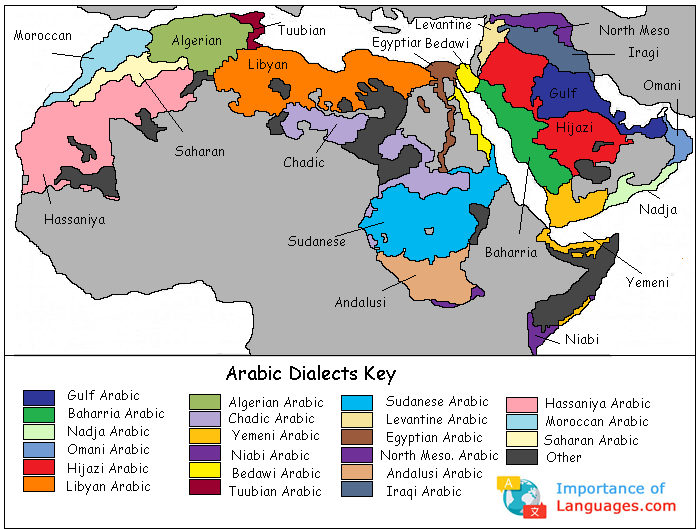
Arabic Dialects Map

Map of the different Arabic Language Dialects

Arabic Dialects List

  • Sudanese Arabic – Mostly spoken in the Sudan
  • Levantine Arabic – This dialect is often heard in Syria, Lebanon, Palestine, and western Jordan
  • Gulf Arabic – Mostly heard throughout the Gulf Coast from Kuwait to Oman
  • Najdi Arabic – This dialect is most often heard in the desert and oasis areas of central Saudi Arabia
  • Yemeni Arabic – This dialect is most common to Yemen
  • Iraqi Arabic – The dialect most commonly spoken in Iraq
  • Hijazi Arabic – This dialect is spoken in the area west of present-day Saudi Arabia, which is referred to as the Hejaz region.
  • Egyptian Arabic – This is considered the most widely spoken and understood “second dialect.” It’s mostly heard in Egypt
  • Maghreb Arabic – Spoken mostly in Algeria, Tunis, Morocco, and western Libya
  • Hassaniiya Arabic – Most often spoken in Mauritania
  • Andalusi Arabic – This dialect of the Arabic language is now extinct, but it still holds an important place in literary history.
  • Maltese Arabic – This form of Arabic dialect is most often found in Malta.

Different Arabic dialects of the Arabic language are spoken in many different nations and regions around northern Africa and the Middle Eastern nations. However, in many areas, the differences in regional dialects may make one Arabic speaker nearly incomprehensible to another. In most cases, the different dialects don’t have a specific written form of the language, but there’s usually a certain amount of literature that accompanies each dialect, including poetry and plays. This is especially true for the dialects spoken in Egypt and Lebanon.


Interested in further study into Arabic or confused on where to start? I recommend reading our Arabic Beginners Guide

Categories
Learn Arabic Language

Learn Arabic Alphabet – How to Write Arabic Language Guide

Learn Arabic Alphabet is very important when it comes to learning to write and read the Arabic Language. So make sure to practice pronouncing and writing the Arabic Alphabet whenever you can. As many times as you can.


Arabic Alphabet Table

Arabic alphabet letters are written horizontally from right to left.

Arabic numbers are written the opposite way, left to right. The Arabic alphabet contains Arabic letters in which most of them are constants. Learn Arabic Alphabet has no capital or lower case letters but does changes slightly depending on the position of the letter in the word. Vowel diacritics and other symbols mark if Arabic vowels are either long or short or pronounced differently.


Arabic vowel diacritics

Learn Arabic Alphabet is written like cursive writing where the Arabic letters are linked together. As mentioned above each Arabic Alphabet letter has four forms depending on where it is located within the word. Theses four forms are called: Isolated, Initial, Medial, and Final. Refer to the chart below for further explanation of what each one means and what each letter looks like when in that form.

Six Arabic alphabet letters (a(??)? d(??) d(??) z(??) r(?) w(??)) only have two forms.(Isolated and Final). Example Arabic word below to demonstrate this.


Arabic Alphabet Written Table

In the example “Marhaba” or Hello in Arabic. Since the Arabic letters for “a” and “r” have no medial forms causes the “r” to be in it’s final form causing the break in the word. So don’t stress out if there is a break within the word your trying to pronounce. Complete chart to Learn Arabic Alphabet letter when written in each of the four forms.


Exit mobile version