Categories
Learn Italian Language

Learn Italian Language Guide

Italian is truly an amazing language to learn. Italian is a Romance language spoken by over 80 million people in Italy, Switzerland, San Marino, the Vatican City, Malta and Eritrea. There are also many Italian speakers in Chile, Argentina, Brazil, Australia, Canada, the USA and the UK.

Why Learn Italian?

Like many languages in Europe, Italian is a romance language that has the most characteristics in common with Latin. Most native speakers of Italian are bilingual of both standardized Italian and their regional dialect.

Reasons to learn Italian include visiting an Italian country, your significant other speaks Italian, to increase job viability or one of the others listed below.

Italian Food, art, and Fashion: Many people around the world say Italian food is one of the most attractive and tasteful cooking in the world. Milan is the fashion capital of the world so if you like the fashion, supermodels, and world-class designers. If you are a fan of the opera and want to understand your favorite opera singers when they belt out those really high notes.

Understand the Cultural Importance of Italian: Maybe you fell in love with the rolling hills of Tuscany on your first visit to il bel paese—or maybe you fell in love with an Italian! Maybe your grandparents emigrated from Italy, so you want to investigate your family history. Perhaps you’re an aspiring musician who wants to learn what adagio, allegro, and andante mean or an opera singer who wants to improve her pronunciation.

Italian is truly an amazing language to learn. I hope you find this article helpful in narrowing and strengthening your reasons to learn Italian

This guide was written for Italian Beginners that don’t know where to start learning the Italian language.

Italian is spoken by Eighty Million people over in Italy and other countries in Europe.

Learn Italian

Learning Italian Menu


Countries where Italian is spoken:

  • Italy
  • Malta
  • San Marino
  • Parts of Switzerland
  • Croatia
  • Slovenia
  • France.
  • Vatican City

Italian Language Interesting Facts

The longest word contains 29 letters.

The longest word in Italian is the 29-letter esofagodermatodigiunoplastica. Refers to a reconstructive surgery related to the removal of the stomach.

The official language of classical music is Italian

Classical invented in Italy during the Renaissance, and thus became the standard language used in classical music.

Italian didn’t become a single, official language until 1861.


Learn Italian Alphabet Letters

The Italian alphabet contains 21 letters of the English Alphabet. The letters j, k, w, x, and y are missing from the Italian alphabet but they do however appear in words burrowed from other languages.

The following letters do appear in Italian. They are used mainly in foreign words borrowed from other languages and their pronunciation is based on the word they appear in.

Italian alphabet

The Italian alphabet uses two diacritical accent marks primarily used on vowels. An incorrect or missing accent mark is a spelling mistake just as an incorrect or missing letter would be.

The Acute Accent can only be included on the vowels e, or o when they end words.

The Grave Accent can be included on all vowels that end words.


Italian Numbers

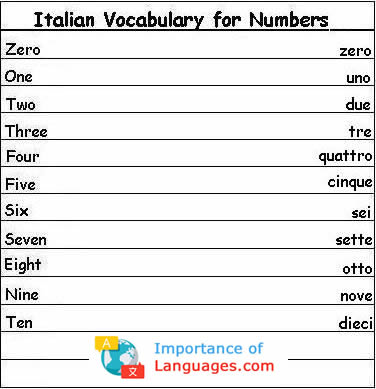
Italian Numbers are like English but with the different pronunciation.

how to speak Italian numbers?

Italian vocabulary numbers 1-10

Italian vocabulary numbers 1-10

Italian Numbers 1-100

Italian Numbers 1- 100

Map of the key Italian Language Dialects

Within any language or language group, there may be significant changes in speech, vocabulary, and pronunciation. The term used to describe these changes is called a dialect. Some words or phrases that exist in one dialect may exist or be absent from a different dialect.

Map of the key Italian Language Dialects

Italian Vocabulary

Logical next step for Italian Beginners after learning the Italian Alphabet would be to start developing your Italian vocabulary with Italian words and phrases.

Italian Grammar

The Italian grammar rules you must follow and understand to properly speak the Italian language.

Basic Italian Vocabulary Words
HelloCiao
Goodbyeaddio
Yes
Nono
Pleaseper favore
Thank YouGrazie
Welcomebenvenuto
Excuse Memi scusi
Sorryscusa
Where?bove?
When?Quando?
How?Come?
Who?Chi?
Which?Quale?

Italian Grammar Rules

The fun part of learning any language. Grammar!

The “rules” you must follow to properly speak a language. But don’t worry about how hard learning Italian Grammar might feel at first. Learning Italian grammar rules is one of the most effective ways to speed up your ability to speak the Italian language.

Italian Grammar Rules: Sentence Structure

• The basic sentence structure of Italian is subject-verb-object. Just like English.

Italian Sentence Structure

Italian Grammar Rules: Nouns and Pronouns

• Italian Nouns can be either Masculine or Feminine
• Most Italian end in a vowel sound, those that don’t are usually of foreign origins.
• Nouns that end in “-ore” are usually Masculine while nouns that end in “-ione” are Feminine.

Italian Masculine Feminine Examples

Italian Grammar Rules: Verbs

• Italian Verbs usually have a “Mood” attached to them to indicate the speaker or writers feeling to the action being described.
• There are 4 moods in Italian: Indicative, Subjunctive, Conditional, and Imperative. Three more moods exist in Italian that doesn’t indicate the speaker. Theses are Infinitive, Participle, and Gerund.
• Each mood can be divided into one or more tenses.(Past, Present, Future)


Italian Grammar Rules: Adjectives

• Most Italian Adjectives are either plural or singular depending on the ending
• Singular Adjectives can be either Masculine or Feminine and usually end in “-e”
• Plural Adjectives usually end in “-i”. In the case of a word ends in “-io” the “o” is dropped from the word to form the plural.

Most Italian end in a vowel sound, those that don’t are usually of foreign origins. Italian has several “moods” for its verbs that indicate the speaker’s feelings towards the action being done as well as what “tense” or time it’s being done. Italian Adjectives can have a gender as well depending if they are singular or plural.

Italian Adjective Examples

Learning Italian grammar rules can be considered the cornerstone of the language and will take some time to learn but creates a sturdy foundation to help you completely learn Italian in no time. Take the time to let these points soak in, then build on them as you continue your Italian studies. Good luck, and have fun learning Italian


Common Italian Phases

Italian Greetings
Hi! / Hello Ciaol
Good Morning!Buona Mattina
Good Evening!Buona Sera
Welcome!Benvenuti!
Good ByelArnvederci
How are you?Come sta?
I’m Fine. Thanks!Sto bene. grazle.
And you? E voi?
Common Italian Phases

Common Italian Words

Italian Vocabulary  for Family Members
Family famiglia
Father padre
Mother madre
Grandfather nonno
Grandmother nonna
Grandson nipote
Granddaughter nipote
Grandparents Nonni
Grandchi ldren Nipoti
Brother fratello
5ister sorella
5on figlio
baughter figlia
Uncle zio
Aunt zia
Nephew nipote
Niece nipote
Italian Words for Family

Italian Words for Professions

Italian Vocabulary for Months/Year  
January gennaio
February febbraio
March marzo
April aprile
May maggio
June giugno
July luglio
August agosto
September settembre
October ottobre
November novembre
December dicembre
Italian Words for Months Years

Italian Vocabulary for Emotions/Feelings
Love amore
Worried preoccupato
Angry arrabbiato
Sad triste
Embarassed Imbarazzato
Afraid impaurito
Kind tipo
Happy felice
Impolite scortese
Painful delicato
Bored annoiato
Tired stanco
Sensitive doloroso
Beautiful bello
bel ighted ammirato
Amazed stupito
Hate odio
Italian Words for Emotions

Italian Vocabulary for days/Week
Sunday domenica
Monday Lunedi
Tuesday martedì
Wednesday mercoledì
Thursday Giovedi
Friday venerdì
Saturday sabato
Italian Words for Days / Week

Italian Vocabulary for Colors
Black nero
White bianco
Yellow giallo
Orango arandone
Blue blu
Brown marrone
Green verde
Purple porpora
Violet viola
Red rosso
Gray grigio
Italian Words for Colors

Italian Vocabulary for Animals
bog cane
Cat gatto
Fish pesce
Bird uccello
Pig maiale
Cow mucca
Monkey scimmia
beer cervo
Italian Words for Animals

Italian Vocabulary for Seasons/Year
Spring primavera
Summer estate
Autumn autunno
Winter inverno
Italian Words for Seasons Year

Italian Vocabulary  Words for Anatomy
Head testa
Heart cuore
Brain cervello
Lungs polmoni
Hands braccia
Legs Gambe
Arms stemma
Chest petto
Fingers dita
Toes Toes
Eyes Occhi
Italian Words for Anatomy

Italian Vocabulary for Times/day
Today oggi
Tomorrow domani
Yesterday ieri
Tonight stasera
Morning mattina
Afternoon pomeriggio
Italian Words for Times Days

Italian Vocabulary Words for Countries
China porcellana
France Francia
Italy Italia
North Korea Corea del Nord
South Korea Corea del Sud
United States Stati Uniti
Britain Gran Bretagna
Russia Russia
Japan Giappone
Canada Canada
Iraq Iraq
Egypt Egitto
Germany Germania
India India
Spain Spagna
Mexico Messico
Italian Words for Countries

Italian Vocabulary Words for Continents
Africa l’Africa
Antarctica Antartide
Asia Asia
Australia l’Australia
Eurasia Eurasia
Europe Europa
North America America del Nord
South America Sudamerica
Italian Words for Continents

ItalianVocabulary Words for Homes/Rooms
Home casa
House casa
Apartinent   appartamento
Dining Room sala da pranzo
Bedroom camera da letto
Bathroom bagno
Basement seminterrato
Living Room stanza
Attic Attico
Kitchen cucina
Italian Words for Homes & Rooms

Italian Vocabulary Words for Vehicles
Car auto
Truck camion
Plane piano
Boat barca
Van furgone
Italian Words for Vehicles

Italian Words for Meal Foods
Italian Vocabulary for Mealtimes/Food 
Breakfast prima colazione
Lunch pranzo
dinner cena
Coffee caffè
Fish pesce
Milk latte
Onion cipolla
5alad insalata
Beverage bevanda
Tea
Cake torta
5ausage salsiccia
Cheese formaggio

Italian Vocabulary for Professions 
Doctor medico
Lawyer avvocato
Dentist dentista
Writer scrittore
Banker banchiere
5ecretary segretario
Engineer ingegnere
Farmer agricoltore
Carpenter falegname
Architect architetto
Postman postino
Pilot pi lota
Teacher insegnante
Cook cucinare
Mechanic meccanico
Bartender barista
Italian Words for Professions

Italian Vocabulary Words for Weather
Rain pioggia
Snow neve
Fog nebbia
Cloudy nuvoloso
Sunshine luce del sole
Cold freddo
Warm caldo
Windy ventoso
[/su_column]
Italian Words for Weather

Consider Using a Italian Language Learning Program

Try Language Software

If you are really serious about learning Italian and want to maximize your time then you should consider using an Italian language course to further aid you in your quest to learn Italian. There are several great programs out there that deliver a great language learning experience. The advantages of a language learning program are the organization and having the next step already lined up. Most break down the lessons into 30-minute intervals that can fit into any type of schedule.

Flexible to retry a lesson to make sure you understand what you are learning and give you confidence in succeeding.

Examples of great Italian language programs can be found below.

Categories
Learn French Language

Learn Basic French – French Language Guide

This guide was written for French Beginners that don’t know where to start learning the French language.

French Language History

The Romance language of France was developed from Latin and adopted in France between the 6th and 9th centuries. It is one of the ‘Romance languages’, hence the name of this website, and are also referred to as Romanic languages, Latin languages or Neo-Latin languages

Why Learn the French Language?

You probably already have your own reasons on whether or not you want to begin learning French or not. You may have doubts or simply lack the necessary motivation to learn. Many people have various reasons for learning any language. So I humbly submit 5 reasons on why you should consider learning French as a second or possibly third language.

1. French is one of the world’s major international languages

The French language is spoken by over 200 million people in 43 countries, on five continents. French is one of the most widely taught second languages after English. French is also the official language of the International Red Cross and one of the official languages of the Olympic Games. French is one of the official languages of the United Nations. Knowing French increases your chances of communicating in a non-English-speaking country.

2. Knowing French will improve your vocabulary in English.

Approximately 45% of English vocabulary comes from French. As you learn French, you also enhance your grammar and vocabulary skills in English. Over 50,000 English words have their origin in French. Learning French can also increase your problem-solving skills and improve your memory, self-discipline, and self-esteem. Because progress is very easy to measure, you can quickly take pride in your new abilities. Knowing French can help you attain a number of important life skills and creative thinking skills.

3. French literature is one of the richest and most influential of the modern European world.

Featuring authors such as Rabelais, Montaigne, Racine, Proust, and Marguerite Duras. French-language authors from outside France such as Patrick Chamoiseau, Maryse Condé, and Tahar Ben Jelloun now have international followings. Several well-known philosophers were also French, including Descartes, Pascal, Rousseau, Voltaire, Sartre, and Simone de Beauvoir. These authors’ works are far more appreciated when read in the original language.The prestige of French art, music, dance, fashion, cuisine, and cinema makes French a culturally important foreign language. France is one of the most prolific producers of international films. When you understand French, you don’t have to rely on subtitles to enjoy a French film.

4. French can improve your travel around the world.

Using French enhances your travel opportunities abroad to the Caribbean, Europe, and Africa and beyond. After the United States, France is the second most visited tourist destination in the world. Paris was recently named by Fortune Magazine as one of the top ten global cities. When you speak French, you can be an educated tourist, ask for directions, get your own hotel room or tell a French friend about your own country.

5. Speaking French will increase your job opportunities and salary potential.

French is a major language of high-tech and business in the world. Knowledge of a second language is essential in over 60 occupations. Canada is officially bilingual and an international trading partner requires labelling in English and French on all imported products. More than 1,200 French companies have subsidiaries in the U.S., and France is one of the largest recipients of Canadian Foreign investment. France is a world leader in the development of modern telecommunications, a market with explosive growth potential.


French Beginners Guide

I speak French?

French Alphabet

Learning to read the French Alphabet should be the first stop for French beginners. You should be easily able to understand the French Alphabet because it has the exact same letters and style of writing as English.

Alphabet in French

Alphabet in French

Where they differ though is in pronunciation. French Numbers are the same way.


French Numbers

Whatever second language you choose to study, one of the the first basic principles is to learn how to count. The first step is to learn the English-French translation of Cardinal numbers (that reflect a quantity) and then to learn the Ordinal numbers such as first, second or third (that reflect a position).

Ordinal and Cardinal French Numbers

Cardinal numbers like six and nine reflect a quantity such as two cats or nine rabbits – translated in French as ‘Deux chats’ and ‘Neuf lapins’. When learning to count you will see many similarities with words used in the English language such as ‘cani’ & ‘canine’. Numbers expressed as the sixth or the ninth are referred to as Ordinal numbers and translate as ‘Sixième’ for 6th and Neuvième for 9th.

In respect of the Ordinal, positioning numbers, they are expressed in a different format to English ordinal numbers. French ordinal numbers are expressed with a hyphen such as ‘Vingt-cinquième’, in the same format as for English ordinal numbers. There are distinctive words that are used for the first 10 ordinal numbers, and the remainder are formed from the cardinal number by adding “ième.”


French Numbers 1-10

[su_column size=”1/2″ center=”no” class=””]
French Vocabulary for Numbers
Zero zéro
One un
Two deux
Three trois
Four quatre
Five cinq
Six six
Seven sept
Eight huit
Nine neuf
Ten dix
[/su_column]
French Numbers 1-10

French Numbers 1-100

French Numbers 1-100

French Vocabulary

Logical next step for French beginners after learning the French Alphabet would be to start developing your French vocabulary with French words and phrases.

The French Language has close to 1 million words.

  • café
  • en route
  • rendezvous
  • carte blanche
  • faux pas
  • par excellence
  • coup d’état
  • Laissez faire
  • pièce de resistance
  • RSVP
  • Omelette
  • déjà vu
  • pâté
  • soufflé
  • c’est la vie

French Dialect Map – French Language Countries

French Dialect Map

French Grammar Rules

The French grammar rules you must follow and understand to properly speak the French language.

  • French sentence structure is pretty straightforward and follows a Subject-Verb-Object pattern.
  • French nouns have genders: Masculine and Feminine which can greatly change the meaning of the word.
  • French Verb Conjugation refers to the five possible inflexions of a verb: Person, Number, Mood, Tense, and Voice. French Adjectives usually follow the noun or pronoun they modify.

French Grammar Rules: Sentence Structure

French word order is similar to English with a Subject + Verb + Object format.

French Sentence Structure

French Grammar Rules: Nouns and Pronouns

French Nouns have a Gender: Masculine and/or Feminine
• Gender of the Noun can change the meaning of the word.
• Some words are always feminine regardless of who they are referring to.
• A Hyphen is sometimes used at the beginning of a sentence when there is no link to the verb, or used between the verb and pronoun.

French Masculine/Femimine
Masculine Suffix ExemplesFemale Suffix Examples
– age-èe-ure
– eau-ion-ence
– ment-isme-ance
– oir-tè-ette
– one  
and much much more.
Familiarizing yourself with the various suffixes and preffixes is a very important part
of learning nouns is understanding the different between Masculine and Femimine nouns.
French Masculine Femimine examples

French Grammar Rules: Verbs

Each Mood as at least 2 tenses. Past and Present.
• Mood describes the speaker’s feeling towards the action of the verb.
• Indicative Mood is the most commonly used mood and has eight possible tenses.
• French Verb Conjugation refers to the five possible inflexions of a verb: Person, Number, Mood, Tense, and Voice.


French Grammar Rules: Adjectives

French Adjectives usually follow the noun or pronoun they modify
• Adjectives usually follow the noun they describe. If the noun is plural, the adjective takes a plural form, and if the noun is feminine, we put the feminine form, usually by adding an e or by doubling the final consonant and adding e.

French Adjective Examples

Learning French grammar rules can be considered the cornerstone of the language and will take some time to learn but creates a sturdy foundation to help you completely learn French in no time. Take the time to let these points soak in, then build on them as you continue your French studies. Good luck, and have fun learning French.


Common French Words

Your French vocabulary should begin with words you could use in your daily life and should be familiar with already. Below are some useful French vocabulary and expressions for Continents, Weather, Anatomy, Home/Rooms, Vehicles, and Countries from around the world.

Depending on where you live. You are taught a little differently when it comes to continents, if you’re an American like me, you were taught 7 continents. In parts of Europe, some are taught 5-6 continents instead. Either merging Europe and Asia as Eurasia and combining North and South America as one continent.

Basic French Words

Consider an Online French Language Course

If you’re really serious about learning French and want to maximize your time then you should consider using an Arabic language course to further aid you in your quest to learn French. There are several great programs out there that deliver a great language learning experience.

The advantages of a language learning program are the organization and having a next step already lined up. Most break down the lessons into 30-minute intervals that can fit into any type of schedule. Flexible to retry a lesson to make sure you understand what you are learning and give you confidence in succeeding.

Try these French Language online courses:

Categories
Learn Spanish Language

Learn Spanish Language Basics [2025]

Spanish Language Basics Guide

This guide was written for Spanish Beginners that don’t know where to start learning the Spanish language. You probably already have your own reasons on whether or not you want to begin learning Spanish or not. You may have doubts or simply lack the necessary motivation to learn. Many people have various reasons for learning any language. So I humbly submit 5 reasons on why you should consider learning Spanish as a second or possibly third language.

Why Learn the Spanish Language?

1. Growing 350 million Spanish Speaking population worldwide.

Spanish is spoken by an estimated 350 million people around the world and growing! Spanish is currently ranked the Third most commonly spoken language worldwide. Knowing Spanish allows you to communicate with a third of a billion speakers worldwide!

2. Communicate with the growing United State Spanish speaking Population.

Throughout the United States, it is possible to have close contact to native Spanish speakers in many cities or in rural areas. Definitely true in the states surrounding the Mexico border, or other states such as Florida that have a lot of Cuban immigrants or of Cuban ancestry reside. 2008 the estimated amount of Hispanics constituted 14 percent of the nation’s total population.. This will only continue to rise. Currently 53% of students attending US colleges and universities are choosing to learn Spanish over any other language.

3. Learning Spanish can enlighten your travels around the world

Ever wanted to visit a exotic and tropical places around the world? Look no further then the great variety of Spanish-speaking countries that have beautiful landscapes that match that description. Whether it’s Central America or Spain, knowing the Spanish language will enhance your experience with the Spanish locals.

Knowing a countries language and culture before you visit, can give you a better understanding than someone then a non-Spanish speaker. It’s always easier and more enjoyable when you can speak Spanish fluently with native speakers when you travel. Putting forth just a little effort into learning the Spanish language can improve your appreciation of the places you visit.

4. Learning Spanish can improve your employment chances.

Additional skills such as knowing a second language can be beneficial when looking for a job in this troubled market today. In fact, many jobs today require a minimum of basic proficiency in another language.

Especially when the business world becoming more international and global, contact with people from other countries in the word is becoming more necessary. Just having a basic knowledge in another language separates you from other applicants for a job you are applying for. Such jobs include nurses, social workers, teachers, salespeople, translators, and much more. Often Bilingual employees receive larger salaries then their monolingual counterparts. Cause after all, who couldn’t use more cash?

5. Learn Spanish to make lifelong friends.

The most important reason to learn any language is to communicate with people around you. Some people don’t realize this fact because they are usually intimidated at meeting new people that otherwise wouldn’t be possible. Communicating with someone in their fluent language is a great icebreaker and allows you to connect better then using hand gestures or body language.

Even though becoming fluent in Spanish can take it’s toll of effort, dedication, and the time learning the language. The benefits can be much greater for your relationships at home and aboard.


Learn Spanish Alphabet

Learning to read the Spanish Alphabet should be the first stop for Spanish beginners.

Spanish used to have 30 letters until 3 of them were removed(Ch, ll, and rr). Spanish has 27 letters, 26 from the English Alphabet with the letter “ñ” added in plus different pronunciation as well.

The Spanish Alphabet currently contains twenty-seven letters including the twenty-six from the English Alphabet with extra letter ñ.

Some Spanish letters of the Spanish Alphabet are pronounced differently than their English counterparts.

There are two kinds of syllables in Spanish:

  • Stressed (tónicas)
  • Unstressed (átonas).

One-syllable words will be either tónicas or átonas. In words with more that one syllable, only one can be stressed. Spanish as changed over recent years, removing letters from the Spanish Alphabet.

So make sure to practice pronouncing and writing the Spanish Alphabet whenever you can. As many times as you can.

Practice with the Spanish alphabet with pictures below:

Spanish Alphabet Chart

Spanish Alphabet Chart

How many words in the spanish language?
The Spanish Language has about 150,000 Official Words

Learn Spanish Numbers

Spanish numbers are similar to English but with a different pronunciation. Further information about both the Spanish Alphabet and Spanish Numbers linked below.

Understanding how to write Spanish numbers should take very little time and effort to learn.

Spanish numbers are easy to understand because they are written exactly like English Numbers but are pronounced differently.

It’s actually pretty straightforward when it comes to learning how to use the Spanish number system.

Pronouncing Spanish numbers on the other hands get a little bit tricky. Spanish numbers 1 to 10 should be your primary focus when you begin.

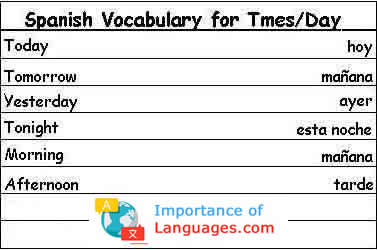
Spanish Numbers 1-10

Spanish Vocabulary for Times/Day
Today hoy
Tomorrow manana
Yesterday ayer
Tonight esta noche
Morning manana
Afternoon tarde
Spanish Numbers 1-10

Spanish Numbers 1-100

Spanish Numbers beginning at twenty gain prefixes and on top of that add “y” to the mix. So overall the pattern becomes an appropriate prefix + y + base number.

Spanish numbers after gain various prefixes added to the base number. To illustrate what I mean, here are Spanish numbers 1 to 100 and their prefixes.

Example of how to write the pronunciation of Spanish numbers below.

Spanish Numbers-1-100


Pronouncing Spanish Numbers Examples

Understanding how to write Spanish numbers is really that simple to learn. Only takes an hour or two to fully memorizes the Spanish number system.


Learn Spanish Vocabulary

The logical next step for Spanish beginners after learning the Spanish Alphabet would be to start developing your Spanish vocabulary with Spanish words and phrases.

Basic Spanish Vocabulary Words

Basic Spanish Vocabulary Words

Spanish Vocabulary for Times & Days

Spanish Vocabulary for Times/Day
Today hoy
Tomorrow manana
Yesterday ayer
Tonight esta noche
Morning manana
Afternoon tarde

Spanish Vocabulary for Months/Year

Spanish Vocabulary for Months/Year
January enero
February febrero
March marzo
April abril
May mayo
June junio
July julio
August agosto
September septiembre
October octubre
November noviembre
December diciembre
Spanish Vocabulary for Months/Year

Spanish Words for The Weather

Spanish Vocabulary Words for Weather
Rain lluvia
Snow meve
Fog niebla
Cloudy nublado
Sunshine sol
Cold frio
Warm caliente
Windy ventoso
Spanish English Words for The Weather

Spanish Vocabulary Words Meal times Food

Spanish Vocabulary for Mealtimes/Food
Breakfast desayuno
Lunch almuerzo
Dinner cena
Coffee cafe
Fish pescado
Milk leche
Onion cebolla
Salad ensalada
Beverage bebida
Tea te
Cake pastel
Sausage salchicha
Cheese queso
Spanish Vocabulary Words Meal times Food

Spanish Words for Animals

Spanish Vocabulary for Animals
Dog perro
Cat gato
Fish pescado
Bird pajaro
Pig cerdo
Cow VQCQ
Monkey mono
Deer ciervo
Spanish Words for Animals

Spanish Words for Anatomy

Spanish Vocabulary Words for Anatomy
Head cabeza
Heart corazon
Brain cerebro
Lungs Puhnones
Hands Manos
Legs Piemas
Arms armas
Chest pecho
Fingers Dedos
Toes Dedos de los pies
Eyes Ojos
Spanish Words for Anatomy

Spanish Words for Colors

Spanish Vocabulary for Colors
Black negro
White blanco
Yellow amarillo
Orange naranja
Blue azul
Brown marron
Green verde
Purple purpura
Violet violeta
Red rojo
Gray gris
Spanish Words for Colors

Spanish Words for Professions

Spanish Vocabulary for Professions
Doctor medico
Lawyer abogado
Dentist dentista
Writer escritor
Banker banquero
Secretary secretario
Engineer ingeniero
Farmer agricultor
Carpenter carpintero
Architect arquitecto
Postman cartero
Pilot piloto
Teacher maestro
Cook cocinar
Mechanic mecanico
Bartender barman
Spanish Words for Professions

Learn Spanish Phrases

Romantic Spanish Phrases

Romantic Spanish Phrases
I love you Te amo
I love you a lot Te quiero mucho
Kiss Me Dame un beso
Do you love me? Me quieres?
What would I do without you? Que haria yo sin ti?
You’re the man of my dreams. Tu eres el hombre de mis suenos.
You’re thewoman of mv dreams. Tu eres la mujer de mis suenos.
Hug and Kisses Abrazo y besos

Romantic Spanish Phrases


Spanish Vocabulary For Emotions Feelings

Spanish Vocabulary for Emotions/Feelings
Love amor
Worried preocupado
Angry enojado
Sad triste
Embarassed Avergonzada
Afraid asustado
Kind tipo
Happy feliz
Impolite descortes
Painful sensible
Bored perforado
Tired cansado
Sensitive doloroso
Beautiful hermoso
Delighted encantado
Amazed asombrado
Hate odio
Spanish Vocabulary For Emotions Feelings

Spanish Vocabulary Words for Continents
Africa Africa
Antarctica Antartida
Asia Asia
Australia Australia
Eurasia Eurasia
Europe Europa
North America America del Norte
South America America del sur
Spanish Words for Continents

Spanish Words for Countries

Learn Spanish Grammar

The Spanish grammar rules you must follow and understand to properly speak the Spanish language. Spanish sentence structure follows a Subject + Verb + Object format to their sentences. Spanish Nouns can be either masculine and feminine. Masculines nouns are preceded by the article “el” and usually end in a “o”. Feminine nouns are preceded by the article “la” and usually end in an “a”. Although there are Exceptions. Spanish Verbs have 5 tenses. Past, Present, Future, imperfect, and subjunctive. Spanish adjectives appear after the noun they describe. More information about Spanish grammar can be found below.

Examples of Spanish Verbs

Examples of Spanish Verbs

Spanish Accents

Spanish Accent Marks

The acute accent marks are used as an aid in pronunciation and also to distinguish some sets of words that are otherwise spelt alike and pronounced alike but have different meanings or different grammatical usages.

The dieresis, also known as the umlaut, which is placed over the u when it pronounced after a g in the combinations güe and güi. Umlauts are rarer than the other types of diacritical marks.

The tilde is used to distinguish n from ñ. In a technical sense, this might not be considered a diacritical mark, since n and ñ are separate letters of the alphabet


Online Spanish Language Learning Program

Why should you use online Spanish software to learn Spanish?

There are a variety of reasons why being conversant in Spanish is beneficial, but here are some of the main one:.

1. Knowing Spanish can broaden your professional opportunities. With the growing importance of the Hispanic market in the US, an increasing number of companies are looking for employees who can speak both English and Spanish to help them take advantage of this burgeoning market.

2. Being able to speak Spanish can enhance your travels abroad. Spain and the Latin American countries are some of the most beautiful places in the world. But if you’re only visiting them through guided tours, then you’re not really experiencing these countries at their best. Being able to speak Spanish allows you to experience these countries the way natives do, as well as allowing you to interact with the locals.

3. Being fluent in Spanish provides you with the opportunity to study abroad. You are more likely to be accepted to exchange student programs if you can speak the language of the country you’re being sent to. Exchange programs also allow you to earn valuable academic credits toward graduation as well as looking good on your resume.

But what are the advantages of using speak Spanish software rather than learning through formal classes or using other learning methods?

1. You can learn in your own spare time and at your own pace. You don’t have to adjust your working schedule to accommodate classes.

2. Speak Spanish software provides lessons in all the core language skills: speaking, reading, listening and speaking.

3. Speak Spanish software allows you to begin conversing in the language quickly by teaching you some of the most commonly-used phrases and words.

4. Speak Spanish software uses a wide variety of learning techniques, ranging from conversational practice, vocabulary and grammar exercises to interactive learning games.

5. The software includes cultural activities to teach students about the culture behind the language they are studying.

6. The software package provides you with online support from instructors who will evaluate the student’s progress and provide guidance and recommendations to ensure that they are learning the language correctly.

Examples of great Spanish Language Programs can be found below:

Categories
Learn Arabic Language

Learn the Arabic Language – Learn the Basic Arabic Language

Learn Basic Arabic Language Guide

Arabic is spoken by an estimated 280 million people around the world and is the official language of 20+ Countries in the Middle East and Northern Africa. You probably already have your own reasons on whether or not you want to begin learning Arabic or not. You may have doubts or simply lack the necessary motivation to learn. Many people have various reasons for learning any language. So I humbly submit 5 reasons on why you should consider learning Arabic as a second or possibly third language.

Why Learn the Arabic Language?

  1. The high demand and low supply of English Arabic-speakers.
    Relatively few Americans attempt to learn Arabic. With the increasing influence of the Middle East in international affairs, there is an extreme shortage of workers in the United States that know the Arabic language and culture. People who study Arabic can find careers in various fields such as: Journalism, Business, Financial, Translation, Consulting, and various other career opportunities to name a few. As little as 1% of 12,000 FBI agents have very little knowledge of Arabic, and this includes those agents that can only read or write a few words of Arabic.
  2. Arabic is the 5th largest spoken language in the world.
    Arabic is the official language of over 20 countries and there are well over 300 million native speakers of the language. These speakers are largely concentrated in the Middle East, but there are minority groups of native speakers throughout the world. It is also an official language of the United Nations, the Arab League, the Organization of Islamic Conference, and the African Union.
  3. Arabic is essential in understanding the Qu’ran and Islam Arabic language is an important part of Islamic religion, in fact an inseparable part.
    It is the language of the Holy Qur’an. Millions of Muslims and native speakers around the world learn Arabic just to study and understand the Qu’ran.
  4. Europe / America has an increasing Arab-American minority.
    According to the U.S. Census Bureau’s 2002 census, there are 1.2 million people of Arab heritage residing in the United States. Though a relatively small population, their numbers are quickly growing; people of Arab ancestry in the U.S. increased by about 40% during the 1990s. Intercultural understanding begins at home. Even just a basic knowledge of the Arabic language and culture can improve understanding and acceptance of this often misunderstood and misrepresented group of Americans.
  5. Arabic influence on products from around the world.
    The export of concepts, products, and cultural practices from Arabic-speaking peoples is evident in the vocabulary that Arabic has lent other languages. Algebra was invented by Arab mathematicians in medieval times. Such staple products as coffee and cotton came from the Arab world, as well as jasmine, lemon, and lime. Other Arabic loanwords appearing in English denote such diverse things as henna, macrame, lute, mattress, gerbil, sorbet, safari and muslin. The influence of Arabic culture is even apparent in the English language.

Each region has it’s own regional Arabic dialect, although the standard dialect is Modern Standard Arabic which is understood by many but can be considered too formal.


How difficult is Arabic to Learn?

Depending on your approach to learning Arabic can be a moderately hard language to learn if you don’t have the right mindset. You should always try to maximize your resources and time for the best learning experience possible.

All languages evolve over time and Arabic is no exception. To indisputably understand the importance of the Arabic language you have to learn the actual language yourself to help to receive the full benefit of this amazing language later


Learn Arabic Fast

Five Easy techniques to Learn Arabic Rapidly

Learning to speak Arabic can be quick and easy with our Arabic language courses and learning aids. Whether you are looking for an Interactive Arabic course like Rocket Arabic or other computer-based Arabic language courses like Rosetta Stone, we have what’s right for you. Before you know it, you’ll be on your way to learning Arabic fast.

Learn Arabic fast on the Go
Having a busy life shouldn’t keep you from trying to learn Arabic fast. We offer several Arabic language courses that will allow you to learn to speak Arabic while driving, exercising, doing housework, etc. This means you can learn Arabic anywhere, anytime. The ease with which you’ll learn Arabic is amazing.

Can I Really Learn Arabic Fast?
The answer is YES! Learning Arabic is easier than ever with our full line of Arabic language courses and learning aids. Learning Arabic is not as hard as you might think. With all the available Arabic resources, you can learn while commuting, while watching TV or while sitting in front of the computer. If you want to learn to speak Arabic, there is no excuse to not. The world is at our fingertips and learning Arabic will help you better communicate with everyone.

Here are 5 tips to Learn Arabic Fast:

  1. Keep setting Objectives
    Decide how many minutes each day you are going to set aside for your Arabic studies. Stick to this no matter what comes about. Setting a goal to study each day will help you more quickly achieve your goal to learn Arabic fast.
  2. Set a Daily Routine
    Know what time you are going to study Arabic each day. This is part of your goal setting but of equal importance to your success. Your time might be first thing in the morning. Or it might be on your evening commute home. Whatever the time is, stick to it.
  3. Write Down Arabic Words and Phrases
    Buy yourself a notebook to use for your Arabic studies. In your notebook take notes of the words or phrases that may be difficult for you to remember. Spell them out. Write their definition. You’ll be surprised with how much this will help you in your goal to learn Arabic fast.
  4. Collect Arabic Articles and Pictures
    Keep a folder and collect Arabic articles and pictures about the language and country you are learning about. You might find an article about Egypt or Iraq. Add those to your folder. The internet is full of Arabic language newspapers. Print off some articles to look over and see how many words you recognize.
  5. Have Fun Learning Arabic!
    There is no sense setting a goal to learn Arabic if you don’t have fun. Use your new language skills to practice with native Arabic speakers. And before you know it, you’ll be on your way to learning Arabic. Good luck and have fun!

Arabic Alphabet

Arabic Alphabet Guide

Learning to read the Arabic Alphabet should be the first stop for Arabic beginners.

The first thing that sticks out is that Arabic is written right to left.

Arabic has 28 characters and most of them are consonants with no capitals and small letters.

Unlike the Arabic alphabet, Arabic numbers are written left to right like English.


Arabic Number System

arabic numbers 1-100

Understanding how to write the Arabic number system takes very little time and effort to learn.

When you write Arabic numbers, they go from left to right, like English words and numbers, but the opposite for the Arabic language. Here are some examples of how to write Arabic Numbers.

It’s actually pretty straightforward when it comes to learning how to use the Arabic number system. Pronouncing Arabic numbers on the other hands get a little bit tricky. Arabic numbers 1 to 10 should be your primary focus when you begin.

Arabic Vocabulary for Numbers

Zero Sifr
One Wahid
Two Itnan
Three Talatah
Four Arab’ah
Five Homsoh
Six Sittah
Seven Sab ‘ah
Eight Tomanlyyah
Nine Tis’ah
Ten Asarah

Arabic numbers after gain a suffix added to the base number. To illustrate what I mean, here are Arabic numbers 1 to 100.

Arabic Numbers beginning at ten through nineteen gain the suffix “tashar” added to the base number.
Arabic numbers from 13-19 work like this.
However the number twenty adds wa- to the mix. So it goes base number + wa- + the appropriate suffix. Example of how to write the pronunciation of Arabic numbers below.

Arabic Vocabulary and Phrases

The logical next step for Arabic beginners after learning the Arabic Alphabet would be to start developing your Arabic vocabulary with Arabic words and phrases. Pronouncing Arabic words can be challenging at first because some sounds in Arabic are pronounced deep in the throat and may not be familiar for Arabic beginners at first. I put together two posts of Arabic vocabulary and one post of Arabic phrases for Arabic beginners to start building their knowledge of Arabic Words and Phrases.

How to Introduce Yourself in Arabic

My name is                        Esmee…

What’s our name?             Ma esmouk?

Nice to meet you!             Motasharefon bema ‘refatek

I have to go                      Yajebu an athhaba al aan

I will be right back!           Sa arje’o halan


Common Arabic Phrases: Arabic Phrases

common arabic phases

Consider an Online Arabic Language Course

If you’re really serious about learning Arabic and want to maximize your time then you should consider using an Arabic language course to further aid you in your quest to learn Arabic. There are several great programs out there that deliver a great language learning experience.

The advantages of a language learning program are the organization and having the next step already lined up. Most break down the lessons into 30-minute intervals that can fit into any type of schedule. Flexible to retry a lesson to make sure you understand what you are learning and give you confidence in succeeding.

Free Arabic Language Courses

  • Arabic for Global Exchange – Web site
    • From Carnegie Mellon, a mini-course for individuals with no proficiency or extremely limited knowledge of Arabic language and culture who are about to begin study or work in an Arabic-speaking context.
  • Arabic Language Lessons – Web Site
    • The US Peace Corps serves up  free lessons that will teach you the Arabic spoken in Jordan, Tunisia, Morocco, Chad and beyond.
  • Arabic Lessons on Spotify – Spotify
    • Over 12 hours of Arabic lessons for beginners.
  • Arabic for Beginners 1 – YouTube Free
    • A series of video lessons from Dalarna University in Sweden.
  • Arabic in Jordan – Web Site
    • These lessons from the Peace Corps will help you learn normal conversation in Jordan, rather than focusing on formalities.
  • Foreign Service Institute Written Arabic – Vol 1 – Vol 2
    • Spoken exercises in Arabic and the printed transcriptions. Four textbooks (PDF) and 31 audio lessons (MP3).
  • Foreign Service Institute Levantine Arabic – Web site
    • Introduction to pronunciation. Textbook (PDF) and 19 audio lessons (MP3). Scroll down to the second set of lessons on this page.
  • Foreign Service Institute Saudi Arabic – Web site
    • Covers the urban Hijazi dialect. Textbook (PDF) and 51 audio lessons (MP3). Scroll down to the third/bottom set of lessons on this page.

Categories
Languages

Language Learning Tips Guide

Guide to Language Learning tips

Top Ways to Learn/ Study Languages

• Use a grammar book.

• Play Free Duolingo.

• Play Memrise.

• Ask questions on HiNative.

• Talk to natives.

• Watch Foreign movies.

• Read Foreign Language books.

• Read articles in your target language for your homework/projects.

• Keep a diary.

• Make Language flashcards.

• Make mind maps.

• Use mnemonics.

• Pretend to talk on the phone with someone in your target language.

• Make sentences with what you have around.

• Name everything around you when you’re bored.

• Sticky notes everywhere.

• Fake it till you make it.

• Make mistakes.

• Read comments from youtube.

• Learn poems.

• Translate texts.

• Read dictionaries. (Yes, read, not memorize)

• Play games.

• Think daily at least 10 minutes in your target language.

• Solve grammar exercises online.

• Read grammar explanations.

• Read on Matador articles related to your target language.

• Read vocab lists on tumblr.

• Watch youtube channels with natives.

• Copy-cat what you hear.

• Learn by heart different songs.

• Challenge yourself with more difficult tasks.

• Write a story with your new vocab.

• Translate from your target language to your native and the other way around.

• Make a summary for what you read. (in your target language)

• Find a language partner/pen pal.

• Join a group with learners.

• Talk on Skype.

• Read fanfiction.

• Listen to Forgien Language podcasts.

• Play Closemaster/WordBrewery/BabaDum.

• Teach someone else.

• Try online tests.

How do you start learning a foreign language?

  1. The best way to learn a foreign language is to start young – the younger the better. Indeed, the ultimate goal of learning a foreign language is to be able to speak, not as if you were speaking a second language, but as a native speaker, and this can only really happen if you learn the language from a very young age. Of course, for many people, this is no longer an option.
  2. Aside from the obvious step of taking formal classes, either in person or online, you can try immersing yourself in the foreign language.
  3. There is a huge variety of foreign language MP3/Audio Books available.
  4. Or find foreign language reading material in the language you are trying to learn. Of course, this will be easier if the foreign language is related to a langue you already know. For example, if you speak English you will recognize a lot of the words used in a French newspaper. If you pick up a newspaper written in Arabic, however, you would likely not even know where to begin.
  5. No matter how you are attempting to learn a foreign language, the key is practice, practice and practice. Try to use the foreign language as much as possible, speak it, listen to it, and write it whenever you can. It is especially important to communicate with native speakers. Foreign languages are living, breathing skills that need to be used to thrive, so get out there and start talking maintenance!
  6. Take your TimeTo learn a foreign language in a perfect way, you need to spend much more time in it. Reading, listening and speaking are the three most important factors of learning a language. Therefore, you need to read books, magazines, newspapers in that particular language. Listening to music and speaking will help you to improve your correct pronunciation
  7. If possible, Travel to the Country where the language is spoken nativelyTravelling to that country where the language is spoken natively will give you a good experience. Being there will help you to understand their culture, tradition and their values with the language. In this way you will quickly get used to it, you will speak and pronounce the language as it is, you will behave in their body language, and you will also learn words which you will never learn in books because of regional accents.If you can’t locate any individual that talks your language nearby, aim to get in touch with a person on Skype. People in foreign countries are usually ready to exchange half a hr of speaking in their native tongue for half an hour of speaking in English. A Hello talk account is one more option.
  8. Be a Member of Foreign Language CommunitiesAll languages have their communities and it is a good way to practice and learn your foreign language. It will help you to understand where like-minded people share their thoughts, ideas and opinions.You should connect with a native speaker. Hands down, the best method to discover a new language is to talk it. Too often, individuals spend all their time studying grammar and also memorizing listings of words as opposed to really heading out there and placing just what they’ve learned into technique. Talking with an actual, online individual will assist you to really feel a lot more inspired regarding learning the language compared to staring at a book or computer system screen.Search for a good friend or associate who speaks the language you wish to discover and that ‘d be willing to take a seat with you as well as help you exercise. As an alternative, you could possibly try placing ads in regional on the internet discussion forums or newspapers to locate a person to tutor you or participate in a language exchange.

How Long Will it Take Me to become Fluent a foreign Lanaguage?

It is very important to have the right expectation when you start to learn a language. How long it will take you to become fluent depends on a few factors:

Factor 1: What do you define as fluent?

“Fluent” means different things to different people. Do you want to sound indistinguishable from a native speaker? That is a feat that not everyone can achieve, and if you are to achieve it, it probably means you will have to move to the country where the language is spoken and immerse yourself for years.
But if you want to be able to have a well-flowing conversation with a native speaker, that will be possible in a much shorter time. You can learn up to 80% of a language relatively quickly, but the closer to 100% fluency you want to get, the more effort you have to put in.

So how long does it take you to get to 80%? It depends on the other factors below.


Factor 2: Which languages do you already speak, and which language do you want to learn?

If you are Japanese and want to learn Mandarin, you have the advantage that much of the Chinese characters (“Hanzi”) are very similar to the Japanese ones (“Kanji”).

If you already speak French, it is much easier to learn languages related to French, such as Spanish, Italian, Romanian and Portuguese. In the Netherlands, there are special Dutch classes and learning methods for people from Germany, Sweden, Denmark and Norway. A German friend of mine picked up near-native sounding Dutch while playing with Dutch friends on the street.

Conversely, if you are a Westerner wanting to learn Chinese, it will take you much longer because of the totally different structure of the language and the lack of recognizable words. It is possible to learn the language, but it will take you at least double the time of learning a related language.


Factor 3: How much time and effort can you bring to the table?

Being realistic when you start out learning a language helps to avoid later quitting in disappointment. A major factor in learning languages is how much time you are willing and able to put into it. In mathematics, there may be wonderkids who can simply “get” complex equations almost instantly, but learning a language is hard work, even for the most gifted language learners.

Do not just count how much time you can spend sitting in a classroom, also think about how much time you can spend revising between classes. Are you in an environment where you HAVE TO speak the language? Do you have roommates whom you can only converse within the language you are learning? Do you watch movies or try to read books in the language you are learning? All of these things count towards your time spent learning and really help you to speed up the learning process.

Study the language every day.

People often claim to have studied a language “for 5 years” and also still not be fluent. Yet when they claim five years, they most likely suggest that they examined the language for only a number of hours a week over that whole time period. Let’s get one point clear– if you wish to learn a brand-new language promptly– that is, in the space of a few weeks or months– you’re going to need to commit to examining the language for a number of hrs daily.

Language learning is based on repeating– hammering something into your brain over and over once again up until you remember it. If you damage too lengthy in between study sessions, you are much more susceptible to forget just what you found out last time and also you will throw away beneficial study time going back over just what you’ve currently learned.

You could minimize this lost time by researching everyday. There are no amazing shortcuts when it comes to language discovering– you merely have to commit.
Learn the alphabet of the language you are discovering, if necessary. It will make it substantially much easier for you and you will be able to read and also pronounce words, which will aid you memorize them with greater ease. Plus, it is better for you to be sounding the words out rather than looking at the romanization for the words.


Factor 4: Are you passionate about the language? Are you good at learning languages?

In my life, I have taken classes in English, German, French, Spanish, Ancient Greek, Latin and Mandarin, and in each of these classes, I have seen some fellow learners pick up the language faster than others. It is a matter of how our brain works. Some people are simply better at reproducing sounds and seeing patterns in languages. It also helps if you have learnt other languages before, even if they are not related to the language you are learning. The 3rd language you learn will be easier than your 2nd language.

Conclusion
How fast you will become fluent in a certain language depends on a number of factors, such as:

What you define as being fluent;
How related the language is to your native language;
How much time and effort you can put into learning the language, and
Your passion and aptitude for learning languages.
You might have hoped to get a number from me as an answer to this question. To give a very broad estimate, I would say 80% fluency can be achieved in a matter of months if you dedicate yourself to it full-time (a few hours every day). If you only have a few hours every week, it will take you 1-2 years to hit the 80% mark.


Learn Languages Fast – Three Techniques to Learn Languages Faster

In this article, I will be sharing three of the best and easiest techniques I have to learn languages fast. Learning a new language can be a very exciting and fun journey, I’m sure. Some people, however, want to speed up the process and time it takes to learn languages fast.

Here are some tricks and techniques to help understand how to learn languages fast and easy. But these techniques will still require some time and effort on your part.

Technique 1: Focus on improving your memory skills

The strength of your memory skills is the most important factor when trying to learn languages fast. Most people don’t use their memory skills to their full potential that becomes a big obstacle when trying to learn languages fast.

One of the simplest techniques to increase memory ability is word association. Word association is learning new foreign words with similar words that you may already know. Try to divide the new words into syllables and find words in your vocabulary that that share similar sounds or remind you of every single syllable of the new foreign word you’re trying to learn.

Another easy technique is through repetition. Simply saying and writing a word over and over again. Repeat use of a word helps your memory’s ability to retain and remember that word.

Technique 2: Shorten the amount of time you study.

Adults tend to have a short attention span. In fact, studies have shown that a healthy and fit adult would stay interested and attentive to a certain repetitive task for up to a maximum of 20 minutes! Just 20 minutes! And that’s the attention of a healthy adult towards a task he does daily.

A person usually has a maximum of a 20-minute attention span. This means that after 20 minutes, you’ve most likely lost interest in your lesson. When you’re studying a new language, you should keep your learning sessions to about 15 to 30 minutes at a time. Take frequent, short breaks with some snacks. These breaks and short learning sessions will keep you more focused and your brain will be more sharp, relaxed and focused.

Perhaps the easiest of all the techniques to learn a language fast, you need to keep your study period short. Keep your sessions to 15 to 30 minutes and take 5 to 10-minute breaks in between. Also, be sure to munch on some light snacks to keep your energy.

Technique 3: Create a designated area or room to study.

There are many techniques to learn a language fast and it would be a very big help if you study in the same place and at the same time. Creating a familiar setting for your brain will make it easier for you to learn.

This is why it is necessary that you create your own personal space for your speed learning languages lessons. The human brain responds better when used in an area or situation is comfortable with. A simple area that has little to no distractions. Once your brain gets accustomed to the environment around you, it will automatically program and set your mind into “learning mode.”

It is important to note here that your study area does not need to be a whole room or has to be big or something. It could just be a small desk in your room. Just keep it uncluttered and relaxing. The more relaxing or calming a place is, the same will happen to your brain. And a relaxed and calmed brain means that it is most susceptible to learning new things and more importantly retain the information.

That’s it – the three techniques on how to learn languages fast. Don’t forget that it’s all about your approach – if you believe that something is easy, it will be easy. Really, it all depends on you – every language can be easy and you can learn it fast if you are optimistic and persistent.

Live through your new language on a daily basis. Watch movies, listen to music, podcasts, chat with native speakers, exchange e-mails, speaking on Skype, write a journal, play games. Many people don’t use their new language right from the beginning and that’s why they have a hard time learning it. Good luck and have fun while learning!


Three Easy Tricks to Learn Multiple Languages Easily

Many people start with the belief that learning a second language is something that is beyond their reach. This is very untrue, it is quite possible to learn multiple languages easily. Learning multiple languages actually becomes easier the more you learn.

Truth is, the first language people learn in their life will be their hardest to learn. Because your first language is learned out of necessity by trial and error for the several years of your life. To learn multiple languages easily takes mostly motivation to do.

Learning multiple languages easily is not as far-fetched as you might believe. Most people are scared of the amount of time and effort needed in learning a second language. But there are three easy tricks to learn multiple languages easily, whether you’re learning them at the same time or one at a time in succession.

1.  Creative lessons into a small daily routine

It’s easier to absorb information and knowledge in smaller and more precise lessons. Trying to cram too much information at once, makes it harder to retain it. Breaking down learning sessions of several hours into daily languages lessons of 30 to 60 minutes lessons. Don’t be afraid to spend extra time and attention on things that are giving you trouble.

2. Learning Languages for something your already passionate about.

This can easily be the most useful language learning tool. Because it ties into something you’re already interested in. For example, if you are into Japanese anime, Hindi Bollywood films, or Korean pop music.

You’ll probably experience some grammatical errors at first but merging language learning with something you’re already passionate about is a natural way to develop your language learning skills.

3. Flashcards with everyday objects you interact with.

Many linguists suggest that using everyday objects with flashcards or small notes placed on the object itself. That image of the object with the word next to it, helps your mind associate the word with that object. Basics of learning a language on common words that relate to eating & drinking, transportation, and work.

Remember that learning a language is a long-term commitment. Probably spend the rest of your life learning new words and never be done completely learning. If you plan to learn multiple languages, you should think ahead and come up with a list of priorities, set some goals before going for it.

Three Things Every Language Learner Should Do

Looking for a way to boost your language learning speed and success? Here are a two ideas that I think everyone should embrace.

  • Stick to short study sessions. Scheduling six 20-minute lessons scattered throughout the week will net you more results than one two-hour session on the weekend. The regular exercise you give your faculties will help things stick, apart from giving everything time to sink.
  • Invest in good tools. Every student, whatever subject they’re looking to master, can benefit from the use of proper tools to help them succeed. It doesn’t have to cost you an arm and a leg either. A good language-learning software, along with a few small reference materials, can prove a terrific set of tools to get by on.
  • Make time for practice. Whether you get your practice time by going through lessons with fellow learners or diving into a crowd with native speakers, you need to find an outlet to use what you’ve learned. Without that, you’ll like find a difficult time integrating it into your natural skillset.

Those three things sound particularly simple and basic. Yet, you’ll be amazed at the number of language learners who aren’t doing them. In my opinion, they’re the foundation of every successful language training endeavor. Get them done and you give yourself a bigger chance of coming out on top.

Categories
Languages

Most Useful Second Languages for English Speakers [Essay]

Second Language Acquisition Guide

When the world talks about science, culture, economy or politics, it speaks English. English speakers don’t really need a second language at all. So, what’s the use of a second language when the first one is enough? English speakers can look for luxury items: cultural and linguistic enrichment.

Which Second Language for English Speakers?

Second Language Criteria

In this article, I will evaluate the world’s major languages for their usefulness, according to three different criteria:

  • Demographics
    Opportunity to use the language actively: the number of native and second language speakers, and the chances of communicating with them in this language: use as a lingua franca. It’s not simply a matter of numbers. Mandarin is by far the most spoken language but it is concentrated in one country, China, and that reduces the impact. In the case of Hindi, educated speakers will very likely also speak English, so the opportunity to speak to people in Hindi is greatly reduced.
  • Personal Impact
    This subjective criterion looks at the impact on the learner. How does this language study increase the learner’s own sophistication regarding languages, whether English or another, third language? How does this language make the learner a more culturally literate person?
  • Business factors
    How will this language open new business and commercial opportunities?

Most Useful Second Languages Demographics

I begin with demographics because this is the criterion that first comes to mind in such a discussion. However, this factor only weighs 40 per cent in the ratings, and certain entries here, such as Italian, Swahili and Turkish, will only become understandable when one sees the tables that follow.

Spanish: Approx. 350 million native speakers, with many second language speakers in the Americas, North Africa and elsewhere. It is the official language of about 20 countries. (6 points). It is an important lingua franca in the Western Hemisphere and the Mediterranean, (3 points). (Total: 9 points).

French:
 Despite a relatively small native language base of 130 million, French has a major presence internationally, with a large second language population all over the world and official language status in over 25 countries. It is the working language of many international organizations (4 points). It is also the most recognized lingua franca, after English. (4 points). (Total: 8 points).

Arabic:
 Arabic speakers are hard to quantify. Modern Standard Arabic is the second dialect for 250 million people worldwide, but it is quite differenced from spoken Arabic in each of the 20 countries where it is official. It is an official language of the United Nations and of many international organizations. It is also the language of Islam. (4.5 points). Arabic is a major lingua franca. (2 points). (Total: 6.5 points).

Russian:
 Estimates are as high as 185 million for the native speaking population, and it is the second language in all the nations of the former Soviet Union (3 points). Russia spent much of the Twentieth Century securing the position of its language as the lingua franca in Eastern Europe and Central Asia, and it continues to serve in that capacity, in a greatly diminished way. (2 points). (Total: 5 points).

Mandarin:
It’s the native language of 875 million people, however, they are concentrated in one country, China. It is a second language for the rest of China, Taiwan, and for the Chinese community worldwide. It has little currency beyond its ethnic boundaries and serves as lingua franca only in this context. (Total: 3 points).

German:
 It has approx. 120 million native speakers and many second language speakers throughout Europe. (2 points). It has had moderate success re-establishing itself as the lingua franca of Central Europe, after the disastrous history of the past century, however, this role has been taken up in the meantime by Russian and English (1 point). (Total: 3 points).

Hindustani:
 It includes Urdu at one end and Hindi at the other, with approx. 185 million native speakers in India, and 50 million in Pakistan. It is a second language for another 180 million people in these countries. It has not had success as a lingua franca outside of this context, as that purpose is served by English. It has also been burdened by the reluctance of the Dravidian speaking people of South India to adopt it. (Total: 2.5 points).

Swahili:
 It is spoken natively by 5 million people and by another 50 million as a second language along the East African coast. It’s the official language of Kenya, Uganda and Tanzania (1 point). Swahili is the accepted lingua franca in that area, having achieved nearly neutral “tribal” status on a continent where language is politics, but for dealings with the world beyond, it is normally eclipsed by Arabic, English and French (1.5 points). (Total: 2.5 points).

Portuguese:
 Spoken by approx. 190 million people, it is the official language of Portugal, Brazil, Mozambique, Angola and other states. It has not as yet been able to establish itself as a widely used lingua franca. (Total: 2 points).

Turkish:
 It is spoken by 70 million people in Turkey and Cyprus (1 point). It provides an alternative lingua franca throughout the Turkic speaking lands of Central Asia, replacing the more alien Russian (1 point). (Total: 2 points).

Japanese:
 It is spoken by 125 million people in Japan, but has little currency as a second language or a lingua franca. (Total: 1 point).

Italian:
 It is spoken by 60 million people in Italy, it is also the official language of the Vatican. It has little or no significance as a second language or a lingua franca. (1 point).


Most Useful Second Languages – Personal Impact

Love of Language Learning

Criterion II: Personal Impact: This is the major consideration for the English speaker. It weighs 40 percent in my ratings.

How will the learning of this language help one’s understanding of English?

How will knowledge of this language open up a portal to other related languages? For the first question, Latin languages hold a distinct advantage, since the prestige, erudite forms of English are all constructed out of a Latin vocabulary. The second question favors languages which are seen as leading languages in particular linguistic families, wherever they may be located in the world.

French: It holds a particular position among Latin languages, in that it has been the major conduit of Latin vocabulary into English for the past one thousand years. Fully 30 percent of English words come from French, (6 points). In cultural terms, the centrality of France to European civilization cannot be overestimated, adding 6 more points. (Total: 12 points)

Spanish:
 This Latin language has enormous influence on the English of the Americas. It has, in turn, been influenced by Arabic and the indigenous languages of pre-Columbian America, giving insight into those languages. (4 points). Spanish culture continues to move into the forefront of Western civilization, ironically, often because of the patronage of its greatest rival, North American English (4 points). (Total: 8 points).

Italian:
 It is the direct descendant of Latin. Thus, a knowledge of Italian gives the learner an exceptionally clear idea of the classical language. By the same token, it is the central romance language, and the study of a second or third romance language is greatly facilitated when the first one learned is Italian. (4 points). Italian also opens up a store of cultural knowledge dating back two thousand years, and representing, with the Roman Empire, the Catholic tradition and the Italian Renaissance, some of the very highest achievements of European civilization. (4 points). (Total: 8 points).

German:
 The linguistic significance for English speakers is great. German provides a clear presentation of the Germanic roots of English, and of the syntactic and grammatical logic of the basic English language. As the major Germanic language, it can also be considered a portal to other Germanic languages such as Dutch and Yiddish. (4 points). German culture is also greatly appreciated in Western culture, and its philosophers and artists are key figures. (2 points). (Total: 6 points).

Arabic:
 Although the immediate linguistic impact of the study of Arabic may be hard to discern for the English speaker, the benefits of Arabic in the study of other languages is high. Arabic has greatly influenced other languages of the Middle East and the Muslim world in religion, politics, and social life. Also, the study of the Arabic alphabet opens the way for many other languages, such as Persian, Urdu, Kurdish, etc. (3 points). Arabic culture has had a major influence on western civilization but it remains largely unknown in the English speaking world. Knowledge of the language also leads to a greater understanding of Islam. (2 points). (Total: 5 points).

Hindustani:
 In its Hindi form, it is a window on the origins of the larger Indo-European language family with its Sanskrit vocabulary. As Urdu, it gives a significant introduction to many Persian and Arabic terms. Urdu also uses the Persian form of Arabic script, opening the way to wider studies. It is a starting point for the study of other languages of the subcontinent, an area rich in languages. (3 points). India’s rich culture has become more familiar in the English speaking world, in large part due to India’s ability to project its image through English. However, Hindustani language and Hindi culture are also spread through the Bollywood film industry. Pakistan has yet to make its presence felt, but the potential is there. (2 point). (Total: 5 points).

Russian: It has not had a major influence in the west, given its geographical isolation. It is, however, the major Slavic language, and as such, opens the way to many other Eastern European languages. The Cyrillic alphabet, moreover, is a tremendous asset for reading many of those languages. (2 points). Russian high culture thrived under both tsarism and communism, and it has a significant place in European civilization. (2 points). (Total: 4 points).

Portuguese:
 As a Latin language, Portuguese has a built-in significance for English speakers, even without a direct relationship with English. (3 points). The cultural significance of Brazil, one of the largest nations of the Americas, is continually growing. (1 point). (Total: 4 points).

Mandarin:
 The official Chinese language has had very little influence on English. It has influenced other national languages of the areas, such as Korean and Japanese, and the other “dialects” of China. The Chinese written characters are the same for all of these dialects, and many of these characters are used in Japanese as well. (2 points). Chinese culture, with over two thousand years of history, is quite significant, if not directly applicable to English speaking civilization. (1.5 point). (Total: 3.5 points).

Swahili:
 As the only sub-Saharan language in the group, it serves to introduce the learner to one of the richest linguistic areas of the Earth. It is from the Bantu family of languages, but it incorporates many words from Arabic, Persian, English and French. (1.5 points). It is the language of trade along the East African coast, and as such, is richly descriptive of the culture there. The West African diaspora into the Americas is one of the great mass migrations of the past 500 years, but because of its tragic social dynamics, it has left many millions of people cut off from African culture. Swahili, although it is East African and not West African, can help to fill that gap. (1.5 points). (Total: 3 points).

Turkish:
 Though it has little direct relationship to English, it is the major language of a family of languages that extend eastward to the Chinese interior. It has been influenced by Persian, Kurdish and Arabic, and thus gives some introduction to those languages. (1.5 points). It also represents the culture of the Ottoman traditions, and of modern Turkey and Central Asian Turkistan. (1 point). (Total: 2.5 points).

Japanese:
 This language has had little impact on English and it provides little insight into other languages. It does, however, include many words from Chinese, and uses numerous Chinese characters. (0.5 points). This island nation has been one of the most successful exporters of culture of the Far East during the past century. (1.5 points). (Total: 2 points).


Most Useful Second Languages – Economic Impact

Learning Languages will help you in the Economy

Economic Impact. Is this language used in the world of commerce and business?

Certainly English is by far the most useful language for business, but a knowledge of other key languages can be a distinct advantage.

Twenty percent in the ratings:

French: has a long history as a language of commerce and trade. It is extremely important in the developing world, especially Africa. France itself is the world’s sixth largest economy. (4 points).

Spanish:
 the language of commerce and trade in Latin America. Spain is the world’s ninth largest economy and Mexico is its fourteenth largest. (4 points).

German:
 often used for business in Central Europe. Germany is the world’s third largest economy. (3 points).

Japanese:
 can be extremely helpful in dealing with Japanese business. Japan is the world’s second largest economy. (3 points).

Mandarin:
 China has recently become the world’s fourth largest economy, and it continues to grow. (3 points).

Russian:
 Used in a part of the world where English is not well-known. Russia is the eleventh largest economy and is moving up in the rankings. (2 points).

Portuguese:
 Brazil is the tenth largest economy, and continues to grow. (2 points).

Arabic:
 the language of commerce and trade for the Middle East and the Persian Gulf. (2 points).

Hindustani:
 is used in the world’s twelfth largest economy, however, English is often the language of business in this area. (2 points).

Italian:
 is the language of commerce in Italy, the world’s seventh largest economy. (1.5 points).

Swahili:
 is the language of business along the east coast of Africa. (1 point).

Turkish:
 is used in the world’s seventeenth largest economy, and to some extent in Central Asia. (1 point).
By these criteria we can come up with a ranking of the 12 most useful languages for an English speaker to learn:

French: 24 points
Spanish: 21 points
Arabic: 13.5 points
German: 12 points
Russian: 11 points
Italian: 10.5 points
Hindustani 9.5 points
Mandarin: 9.5 points
Portuguese: 8 points
Swahili: 6.5 points
Japanese: 5.5 points
Turkish: 5.5 points
Some readers may be familiar with George Weber’s well-known piece entitled, Top Languages, which first appeared in the journal Languages Today in 1997. His study rated languages according to their influence in world affairs and world culture. It is interesting, at this point to compare them. Here are Weber’s results:

English: 37 points
French: 23
Spanish: 20
Russian: 16
Arabic: 14
Chinese: 13
German: 12
Japanese: 10
Portuguese: 10
Hindi/Urdu: 9 pts.
The rankings are similar, with some major differences. My criteria are based on tangible and intangible benefits for the English speaker which are not heavily weighed in Weber’s paradigm. Thus, this subjective focus skewers my results in favour of European languages due to the cultural affinity of English for the languages of Western civilization.

Heritage Languages: The most striking example of a difference is my ranking of Italian as number 6, whereas it does not figure in Weber’s top ten. My justification for Italian is the phenomenon of the “heritage language”, i.e., a language that has usefulness in our understanding and appreciation of the past, rather than in the future. Italian is the vehicle for our understanding of ancient history, the development of Latin languages, Renaissance Art and classical music. It is also the ancestral language of over 100 million people strategically placed in both North and South America. For these reasons, it is the heritage language par excellence. Other languages that benefit from this heritage factor in my listings are German and Swahili.

Point values for English? French, with 24 points, is number one in my listing. Where does English stand in relation? If rating it for usefulness for speakers of other languages, I would give it 10 points in each category, for a total of 50 points. I think that the extraordinary position of English in today’s world is indisputable, and considering it to be twice as useful as its closest competition, French, is not a great stretch of the imagination.

The only English point assignment that may require explanation is ten points for linguistic value. The value of English in this area for world speakers is quite a wide-reaching and significant. English is the vehicle for the spread of the classical Latin vocabulary for abstract concepts, for the Greco-Roman terms for a government, science, philosophy, etc.

It absorbs world vocabulary without major spelling changes, effectively spreading new terminology from a variety of sources. As the official language of international organizations, it serves as a showplace for each nation and organization to present itself to the world.

Like the other “empire” languages of Western Europe, French and Spanish, English is propagated by native speakers worldwide with no ethnic, social or political relationship to its motherland. But English goes one step further, English is capable of evolving and developing completely independently of its native speakers. Second language users of English drive the introduction of new words like “informatics” and “ufology” which gain currency first among these speakers.

Foreign governments keep close control of their English language nomenclature, and make changes through the United Nations and non-government organizations. These changes are therefore immediate in English, with no consultation with native speakers necessary.

While some European languages are still calling the capital of China “Peking”, English made the switch to “Beijing” during the late 1980s (for proof, look at contemporary reports regarding the Tian an Men Square events of June, 1989). Recently, the switch from Bombay to Mumbai has happened before most English speakers have even noticed.


Most Popular Languages spoken today

Top 10 languages Most widely spoken native languages globally:

  1. Chinese 1.21 billion
  2. Spanish 329 million
  3. English 328 million
  4. Arabic – 221 million
  5. Hindi – 182 million
  6. Portuguese 178 million
  7. Russian 144 million
  8. Japanese 122 Million
  9. German 90 million

Source: McClatchy Washington

Common language families

History Of Languages Tree

A group of languages that descend from a common ancestor is known as a language family.

The Indo-European family is the most widely spoken:

  • English
  • Russian
  • Hindi

The Sino- Tibetan family

  • Mandarin
  • Other Chinese languages
  • Tibetan

The Afro- Asiatic family:

  • Arabic
  • Somali
  • Hebrew

Bantu languages:

  • Swahili
  • Zulu
  • Other African languages

Malayo-Polynesian languages:

  • Indonesian
  • Malay
  • Tagalog
  • Other Pacific Languages

Dravidian family

  • Tamil
  • Telugu.

Conclusion – The status of English in world affairs puts its native speakers in a unique position. We have the opportunity of living in a provincial English-only environment in which the world comes to us, or we can take advantage of this favoured position to become acquainted with other cultures right within our own language. So, is any second language really useful for English speakers? No study can ever really measure the personal importance of second language learning. That is something we have to discover for ourselves. The fact is that every language is well worth the effort to learn, as every language is a complete way of describing the universe of human achievement, and thus it’s significance is as wide and as deep as we personally make it.

Note on Statistics: The statistics that I have used (population, economic ranking, etc.) come from diverse sources: world almanacs, encyclopedias, US government studies. I make no claims about their accuracy, as they are general estimates. Their importance is in relationship to each other.

Dominic Ambrose has taught languages for over twenty years, from Middle School to Community College, from adult ed to ESL to TOEFL training. He has also travelled as a teacher educator to many Eastern European countries as well as South America, including three years with the Romanian Ministry of Education. Presently, he lives in Paris writing full time, mostly about films and fiction, but he is still fascinated by languages.

Exit mobile version