Italian numbers are easy to understand because they are written exactly like English Numbers but are pronounced differently. Understanding how to write Italian numbers should take very little time and effort to learn. By the end of this you should have a very solid understanding of the Italian number system.
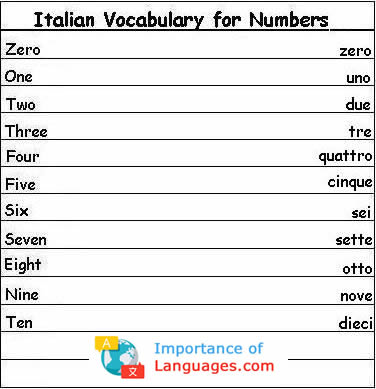
Italian Numbers 1 to 10
It’s actually pretty straight forward when it comes to learning how to use the Italian number system. Pronouncing Italian numbers on the other hands get a little bit tricky. Italian numbers 1 to 10 should be your primary focus when you begin. Italian numbers after gain a prefix added to the base number. To illustrate what I mean, here are Italian numbers 1 to 100.
Italian Numbers are like English but with the different pronunciation.
how to speak Italian numbers?
Italian vocabulary numbers 1-10
Italian Numbers 1 to 100
Italian Numbers beginning at ten through nineteen gain the prefix “” added to the base number. Italian numbers from 13-19 work like this. Italian numbers follow a pattern of prefix + base number. However numbers that use either “” or “tres” are used slightly differently. “Tres” becomes accented(first example below) while “” replaces the vowel at the of the prefix.(Second Example below).
The fun part of learning any language Grammar! The “rules” you must follow to properly speak a language. But don’t worry about how hard learning Italian Grammar might feel at first. Learning Italian grammar rules is one of the most effective ways to speed up your ability to speak the Italian language. Keep in mind this is just a basic introduction into understanding how Italian grammar works.
The Italian grammar rules you must follow and understand to properly speak the Italian language.
The “rules” you must follow to properly speak a language. But don’t worry about how hard learning Italian Grammar might feel at first. Learning Italian grammar rules is one of the most effective ways to speed up your ability to speak the Italian language.
Italian Grammar Rules: Sentence Structure
• The basic sentence structure of Italian is subject-verb-object. Just like English.
Italian Sentence Structure
Italian Grammar Rules: Nouns and Pronouns
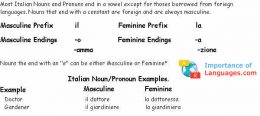
• Italian Nouns can be either Masculine or Feminine • Most Italian end in a vowel sound, those that don’t are usually of foreign origins. • Nouns that end in “-ore” are usually Masculine while nouns that end in “-ione” are Feminine.
Italian Masculine Feminine Examples
Italian Grammar Rules: Verbs
• Italian Verbs usually have a “Mood” attached to them to indicate the speaker or writers feeling to the action being described. • There are 4 moods in Italian: Indicative, Subjunctive, Conditional, and Imperative. Three more moods exist in Italian that doesn’t indicate the speaker. Theses are Infinitive, Participle, and Gerund. • Each mood can be divided into one or more tenses.(Past, Present, Future)
Italian Grammar Rules: Adjectives
• Most Italian Adjectives are either plural or singular depending on the ending • Singular Adjectives can be either Masculine or Feminine and usually end in “-e” • Plural Adjectives usually end in “-i”. In the case of a word ends in “-io” the “o” is dropped from the word to form the plural.
Most Italian end in a vowel sound, those that don’t are usually of foreign origins. Italian has several “moods” for its verbs that indicate the speaker’s feelings towards the action being done as well as what “tense” or time it’s being done. Italian Adjectives can have a gender as well depending if they are singular or plural.
Italian Adjective Examples
Learning Italian grammar rules can be considered the cornerstone of the language and will take some time to learn but creates a sturdy foundation to help you completely learn Italian in no time. Take the time to let these points soak in, then build on them as you continue your Italian studies. Good luck, and have fun learning Italian
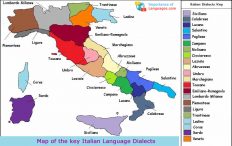
Within any language or language group there may be significant changes in speech, vocabulary, and pronunciation. The term used to describe these changes is called a dialect. Some words or phrases that exist in one dialect may exist or be absent from different dialect.
The following are most commonly used dialects in the Italian language.
Siciliano Italian Dialects
Calabrese ItalianDialects
Lucano Italian Dialects
Salentino Italian Dialects
Pugliese Italian Dialects
Campano Italian Dialects
Molisano Italian Dialects
Ciociaresco Italian Dialects
Laziale Italian Dialects
Abruzzese Italian Dialects
Umbro Italian Dialects
Marchegiano Italian Dialects
Toscano Italian Dialects
Emilano-Romagnolo Italian Dialects
Lombardo Milarnes Italian Dialects
Piemontese Italian Dialects
Ligure Italian Dialects
Trentinese Italian Dialects
Ladino Italian Dialects
Corse Italian Dialects
Veneto Italian Dialects
Different variants of the Italian language are spoken in many different nations and regions around the world, most commonly throughout Europe and Italy. However, the differences in regional dialects may not make one Italian speaker nearly incomprehensible to another. In most cases, the different dialects don’t have a specific written form of the language, but there’s usually a certain amount of literature that accompanies each dialect.
Interested in further study into Italian or confused on where to start? I recommend reading our Italian Beginners Guide
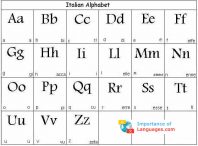
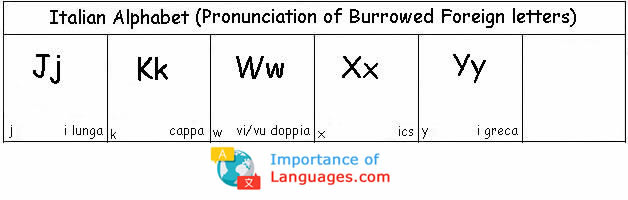
The Italian alphabet contains 21 letters of the English Alphabet. The letters j, k, w, x, and y are missing from the Italian alphabet but they do however appear in words burrowed from other languages. Italian Numbers are like English but with a different pronunciation.
The following letters do appear in Italian. They are used mainly in foreign words borrowed from other languages and their pronunciation is based on the word they appear in.
The Italian alphabet uses two diacritical accent marks primarily used on vowels. An incorrect or missing accent mark is a spelling mistake just as an incorrect or missing letter would be.
The Acute Accent can only be included on the vowels e, or o when they end words.
The Grave Accent can be included on all vowels that end words.
To do the Italian accents marks on the non-Italian keyboard. Alt code can be used. Alt code is when you press then hold down the Alt key on your keyboard then type in numbers on your num pad then release the alt key.
Italian Alphabet is very important when it comes to learning to write and read the Italian Language. So make sure to practice pronouncing and writing the Italian Alphabet whenever you can. As many times as you can.
Italian alphabet
The Italian varies quite a bit from the English Alphabet. Because Italian only has 21 letters. The letters j, k, w, x, and y are missing from the Italian alphabet but they do however appear in words borrowed from other languages.
The fun part of learning any language.. learning grammar! The grammar rules you must follow to properly speak a language. But don’t worry about how hard learning Hindi Grammar might feel at first. Learning Hindi grammar rules is one of the most effective ways to speed up your ability to speak the Hindi language. Keep in mind this is just a basic introduction to understanding how Hindi grammar works.
The Hindi grammar rules you must follow and understand to properly speak the Hindi language.
Hindi sentence structure can be confusing at times but generally tend to follow a Subject-Object-Verb pattern.
Hindi nouns have genders: Masculine and Feminine.
Masculine usually ending in a and Feminine usually ending in “i” or “iya”.
Hindi Verbs usually follow the object of the sentence and can have past, present, or future tenses.
Hindi adjective changes according to the gender of the word they are modifying. More information about Hindi grammar can be found below
Hindi Grammar Rules: Sentence Structure
Hindi uses the sentence structure of subject then object then verb.
Hindi Grammar Rules: Nouns And Pronouns
Hindi Nouns have a Gender, Masculine or Feminine
There are no Definite or Indefinite articles in Hindi
Singular and plural nouns usually aren’t always distinguishable.
Hindi Masculine / Feminie Examples
Hindi Grammar Rules: Verbs
• Hindi Verbs usually follow the object of the sentence • Hindi Verbs do have a tense to them. Past, Present, or Future. • Hindi Verbs can also be either habitual, accelerating or perfective.
Hindi verb examples
Hindi Grammar Rules: Adjectives
• Hindi Adjective change according to Word Gender.
Hindi Adjective Examples
Learning Hindi grammar rules can be considered the cornerstone of the language and will take a while to learn but creates a sturdy foundation to help you completely learn Hindi in no time. Take the time to let these points soak in, then build on them as you continue your Hindi studies. Good luck, and have fun learning Hindi.
Understanding how to write Hindi numbers should take very little time and effort to learn. When you write the numbers, again, they go from left to right, like English words and numbers, but opposite for the Hindi language.
It’s actually pretty straightforward when it comes to learning how to use the Hindi number system. Pronouncing Hindi numbers on the other hands get very tricky. Hindi numbers 1 to 10 should be your primary focus when you begin.
Hindi Numbers 1 to 10
Hindi Vocabulary Numbers
Hindi Number 1 to 100
Hindi numbers after gain a suffix added to the base number. To illustrate what I mean, here are Hindi numbers 1 to 100
Hindi Numbers are very different from other number systems since they don’t follow a format that can be easily explained. They use partial suffixes added to words but language rules change the pronunciation of each number drastically in some cases. So I’ll expand on the above example of how to write the pronunciation for Hindi numbers 1-00 below.
Understanding how to write Hindi numbers is really that simple to learn. Only takes an hour or two to fully memorizes the Hindi number system.
Within any language or language there may be significant changes in speech, vocabulary, and pronunciation. The term used to describe these changes is called a dialect. Some words or phrases that exist in one dialect may exist or be absent from different dialect. The most common dialect in the Hindi language is the Khariboli Dialect. Khariboli is recognized as the standard Hindi dialects.
Hindi Dialects Map
Khariboli Hindi – Which is spoken in Western Uttar Pradesh. Considered to be the Official Dialect of Hindi.
Bambaiya Hindi – A slang form of Hindi-Urdu which is spoken primarily in Bombay (Mumbai).
Brajbhasa Hindi – spoken in the region of Braj.
Kanauji Hindi –
Bundeli Hindi –
Bagheli Hindi –
Chhattisgarhi Hindi –
Hariyanvi Hindi –
Bhaya Hindi –
Chamari Hindi –
Ghera Gowli Hindi –
Different Hindi dialects of the Hindi language are spoken in many different nations and regions around the world, most commonly throughout Southern Asia. However, the differences in regional dialects may not make one Hindi speaker nearly incomprehensible to another. In most cases, the different Hindi dialects don’t have a specific written form of the language, but there’s usually a certain amount of literature that accompanies each Hindi dialects.
Interested in further study into Hindi or confused on where to start? I recommend reading our Hindi Beginners Guide
Learning to read the Hindi Alphabet should be the first stop for Hindi beginners. The Hindi alphabet is also known as the Devanagari alphabet and contains 48 characters. Hindi contains 10 vowels, 2 symbols, 36 constants, and has no upper and lower case of each letter.
Hindi letters are written left to right and linked together by lines through the top of each letter. Hindi Alphabet is also known as the Devanagari Alphabet or script that is used to write Hindi, Marathi, and Nepali. Since the 19th century, it has been the most commonly-used script for Sanskrit and Pali. Devanagari is also employed for Gujari, Bhili, Bhojpuri, Konkani, Magahi, Maithili, Marwari, Newari, Pahari (Garhwali and Kumaoni), Santhali, Tharu, and sometimes Sindhi, Panjabi, and Kashmiri.
Hindi Alphabet letters are written in a cursive shape and is recognizable by a distinctive horizontal line running along the tops of the letters that links them together. Plus they don’t have a no uppercase or lowercase version of each letter. The Hindi Alphabet consists of ten vowels and thirty-six consonants and is written left to right and linked together by the lines through the top of the letters.
Hindi Alphabet Chart
hindi alphabet guide
Hindi Conjunct Consonants Chart
The Hindi Alphabet is a phonetic alphabet which means each Hindi character is pronounced. Hindi consonants carry an inherent vowel which can be altered or muted by means of diacritics or mantra.
Conjunct Consonants occur when two or more consonants appear together in clusters. These can eventually pair up to a having a possible four or five consonants linked together at max. There are an estimated thousand possible combinations of conjunct consonants that can be formed. Some examples of Hindi Conjunct Consonants below.
Hindi Conjunct Consonant Chart
Hindi Alphabet is very important when it comes to learning to write and read the Hindi Language. So make sure to practice pronouncing and writing the Hindi Alphabet whenever you can. As many times as you can.
Within any language or language group, there may be significant changes in speech, vocabulary, and pronunciation. The term used to describe these changes is called a dialect. Some words or phrases that exist in one dialect may exist or be absent from a different dialect. The most common dialect in the Hindi language is the Khariboli Dialect. Khariboli is recognized as the standard Hindi dialects.